1 Carat Lab Grown vs Natural Diamonds: Price, Look, Value
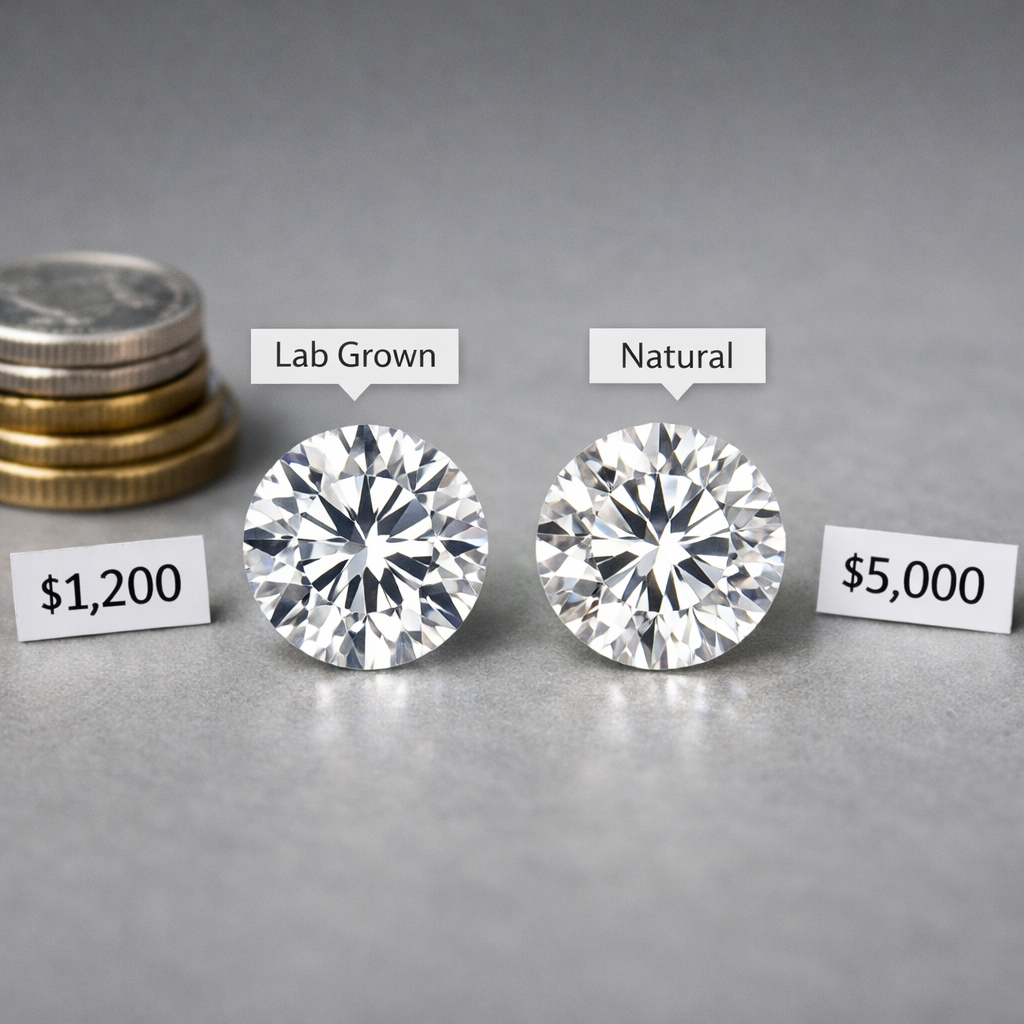
1 Carat Lab Grown vs Natural Diamonds: Price, Look, Value
Choosing between a 1 carat lab-grown and a 1 carat natural diamond comes down to three things: how they look, what they cost today, and how they may hold value over time. For shoppers focused on 1ct center stones, both options can deliver the same sparkle and durability; the real trade-offs sit in price and origin. Below, we compare appearance, current price benchmarks, value retention, and buying steps so you can pick the best diamond for your priorities and budget. Jewelry Guidebook grounds this comparison in current market data and a cut‑first evaluation.
Key takeaways:
- Look: indistinguishable at 1ct when cut and grade match.
- Price: labs are typically 60–80% less.
- Value retention: natural diamonds generally remain stronger over time.
Quick comparison overview
| Factor | What to know at 1 carat |
|---|---|
| Look | Visually identical to the naked eye when cut and graded similarly. |
| Price | Labs are typically 60–80% less; a 1ct G/VS1 lab is often ~$800–$1,500 versus ~$4,000–$6,000 for a comparable natural. |
| Resale | Natural diamonds usually retain more value than lab-grown on secondary markets. |
| Durability | Both are diamond: top hardness (Mohs 10) and suitable for daily wear. |
| Ethics/Environment | Labs avoid mining but can be energy-intensive; impact depends on energy mix and factory practices. Mining impacts vary by origin and standards. |
“Lab-grown and natural diamonds share the same chemical composition and physical properties.” — Brilliant Earth lab-grown guide
Jewelry Guidebook takeaway: prioritize lab-grown if you want maximum size/quality per dollar now; lean natural if origin and stronger resale matter. When cut is equal, light performance is equivalent, as independent testing attests (see the Esdomera overview).
What is a lab grown diamond vs a natural diamond
Lab-grown diamond (40–50 words): A real diamond grown in a controlled chamber using CVD or HPHT in a matter of weeks. It has the same crystal structure—pure carbon in a cubic lattice—as natural diamond and is recognized as a genuine diamond under U.S. standards following updated FTC guidance in 2018.
Natural diamond (40–50 words): A diamond formed deep in the Earth over billions of years under extreme heat and pressure, then brought near the surface by ancient volcanic activity. Its composition and physical properties are identical to lab-grown; the difference is origin, rarity, and supply dynamics.
“Laboratory-grown diamonds have the same composition and crystal structure as natural diamonds.” — GIA researcher, summarized in the Hauser Jewelers comparison
CVD vs HPHT, in brief: CVD (chemical vapor deposition) typically produces high-color (often D–F) crystals with fewer metallic inclusions; HPHT (high pressure high temperature) can show different inclusion patterns due to metallic flux. Both are graded by the same 4Cs framework (cut, color, clarity, carat).
How they look side by side at 1 carat
To the naked eye, a well-cut 1ct lab-grown and a well-cut 1ct natural diamond are visually indistinguishable; only specialized instruments or a lab report can identify origin (see the Brilliant Earth guide cited above). Independent lab testing (e.g., GCAL-style light performance studies referenced earlier) finds no measurable difference when cut quality is equivalent.
Side-by-side checklist to match appearance:
| Parameter | What to match | Why it matters |
|---|---|---|
| Cut grade | Excellent/Ideal with strong symmetry and polish | Cut drives brightness, fire, and scintillation more than origin. |
| Color | Align within one grade (e.g., G vs G/H) | Prevents side-by-side tint differences. |
| Clarity | Align within VS–SI range and inclusion type | Ensures similar eye-cleanliness. |
| Fluorescence | Match levels (None–Medium) | Avoids subtle milkiness or contrast differences under UV. |
| Symmetry/Proportions | Similar table/depth/angles | Keeps light return and face-up size consistent. |
Price comparison at 1 carat
Typical 1ct pricing today (G color, VS1 clarity, excellent cut):
- Lab-grown: ~$800–$1,500
- Natural: ~$4,000–$6,000
These ranges reflect savings of roughly 60–80% for lab-grown at 1 carat, in line with current market roundups in the Tashvi AI guide. Early‑2026 snapshots put averages near ~$1,000 for a 1ct lab versus ~$4,200 for a 1ct natural, per the Javda 2026 market analysis.
Buyer leverage example: On the same budget as a 1.0ct natural, many shoppers step up to a ~2.0–2.5ct lab or upgrade to D–F color/VS1–VVS clarity without sacrificing cut quality.
Trend context: Lab-grown prices have fallen dramatically since 2018 (estimates approach ~95% decline from early retail launch levels) and may continue to soften by mid‑teens annually, which can widen or compress the gap over time depending on supply and demand. Jewelry Guidebook updates these ranges periodically; check live inventories before finalizing a budget.
Value retention and resale realities
Resale value (40–50 words): The percentage of original retail a diamond might recover when sold later through a dealer, marketplace, or consignment. It depends on size, quality, brand, demand, and supply at the time of sale. It is never guaranteed and varies widely by venue and timing.
Current ranges discussed across trade sources: lab-grown often resell around ~10–40% of original retail, while natural stones more commonly achieve ~20–60% depending on grade and market conditions. Multiple market analyses reiterate that lab-grown generally carry much lower resale prospects than mined stones over time. Jewelry Guidebook treats both as jewelry purchases first, not investments.
Decision cue: Pick lab-grown to maximize size/quality now; choose natural if origin/collectibility or potential resale matters more.
Durability and everyday wear
Both lab-grown and natural diamonds are diamond—Mohs hardness 10 for top scratch resistance. They also share the same refractive index (~2.417) and density (~3.52 g/cm³), explaining identical optical potential when well cut.
Practical care tips:
- Choose secure settings (6‑prong or bezel for active lifestyles).
- Schedule annual prong and setting checks with a jeweler.
- Clean monthly with warm water, mild soap, and a soft brush; avoid harsh chemicals.
Environmental and ethical considerations
Lab-grown diamonds avoid land disturbance from mining and are often marketed as conflict-free; their true footprint hinges on the energy mix and factory practices. Mining has improved transparency and community programs in many regions, but extraction still carries localized environmental and social impacts. Ask sellers about:
- For labs: energy sourcing (renewables vs grid), facility certifications, and traceability.
- For naturals: mine of origin, chain-of-custody, and responsible sourcing standards (e.g., RJC participation).
Jewelry Guidebook encourages requesting documentation on sourcing claims and energy use to verify practices.
Certification and grading to trust
Look for grading reports from established gem labs that disclose origin (“laboratory-grown” when applicable) and grade by the 4Cs. U.S. guidance updated in 2018 affirms that lab-grown are genuine diamonds; origin must be clearly disclosed to avoid confusion. Jewelry Guidebook considers clear, report‑matched origin disclosure non‑negotiable.
Verification checklist:
- Confirm cut grade and key proportions (table, depth, angles).
- Note color and clarity grades alongside fluorescence.
- Match the laser inscription to the report number and origin disclosure.
- Review symmetry and polish grades; prioritize Excellent/Ideal.
- Keep digital and paper copies of the report and warranty.
CVD vs HPHT (40–50 words): CVD grows diamond layer-by-layer from a carbon-rich vapor, often yielding high color and fewer metallic flux inclusions; HPHT mimics deep-earth pressure and heat, sometimes leaving metallic inclusion signatures. Regardless of method, stones are judged by the same 4Cs and must be clearly labeled by origin.
Choosing by priorities and budget
- Maximum size/grade per dollar: Lab-grown.
- Stronger tradition/origin story and value retention: Natural.
- Equal for sparkle and durability when cut is equal: Both.
Personas:
- Value seeker: Choose a 1.3–1.5ct lab-grown, Excellent/Ideal cut, D–F color, VS1–VS2.
- Heirloom‑minded: Choose a 1.0ct natural, Excellent/Ideal cut, G–H color, VS2–SI1 clarity.
Market adoption note: By 2024, an estimated majority of engagement ring center stones were lab-grown in many retail channels, reflecting value-focused demand (see the Liori Diamonds report).
Practical buying checklist for 1 carat centers
- Set your budget and decide origin (lab vs natural) based on priorities above.
- Allocate spend toward cut first; it drives performance most.
- Target color/clarity sweet spots: G–H, VS2–SI1 for naturals; D–F, VS1–VS2 are feasible for many labs at similar budgets.
- Confirm certification and origin disclosure; verify a laser inscription matches the report.
- Compare total price vs specs across at least three vendors; sanity‑check current 1ct benchmarks (around ~$1,000 for lab; ~$4,200 for natural) per the Javda market snapshot.
- Inspect videos/images, proportions, and fluorescence; request light‑performance data (ASET/Ideal Scope) when available.
- Choose a protective setting, confirm ring size, and review warranty, resizing, and return policy.
Mini glossary:
- Cut grade (40–50 words): A standardized assessment of how a diamond’s proportions, symmetry, and polish manage light. Excellent/Ideal cuts maximize brightness, fire, and scintillation. Among the 4Cs, cut has the greatest impact on visible sparkle and should be prioritized when balancing budget against appearance.
- Fluorescence (40–50 words): The visible glow some diamonds emit under UV light, graded from None to Very Strong. In normal lighting, Faint to Medium rarely affects appearance and can be cost‑friendly. Strong fluorescence can sometimes introduce a slight milky or oily look, depending on the individual stone.
Frequently asked questions
Are 1 carat lab grown and natural diamonds identical to the naked eye
Yes. When cut and graded similarly, they look the same to the naked eye; Jewelry Guidebook recommends relying on a lab report to confirm origin.
How much cheaper is a 1 carat lab grown diamond
Typically 60–80% less than a comparable natural 1ct, with many lab stones around $800–$1,500 versus $4,000–$6,000 for naturals, depending on grade and market timing. Jewelry Guidebook tracks these ranges and suggests checking current listings before you buy.
Which holds value better over time at 1 carat
Natural diamonds generally retain a higher percentage of resale value than lab-grown. Jewelry Guidebook advises choosing natural if potential resale matters, and lab-grown if maximizing size and quality now matters more.
Which certification should I look for on a 1 carat diamond
Choose a well-known gem lab report that clearly states the 4Cs and discloses “laboratory-grown” when applicable. Verify the laser inscription matches the report; Jewelry Guidebook treats this as standard due diligence.
Can jewelers tell if a diamond is lab grown without a report
Most rely on advanced instruments or lab reports to confirm origin. Always ask for documentation or testing—Jewelry Guidebook considers either essential for clarity and confidence.