Compare GIA and IGI Certified Lab-Grown and Natural Diamond Retailers
Compare GIA and IGI Certified Lab-Grown and Natural Diamond Retailers
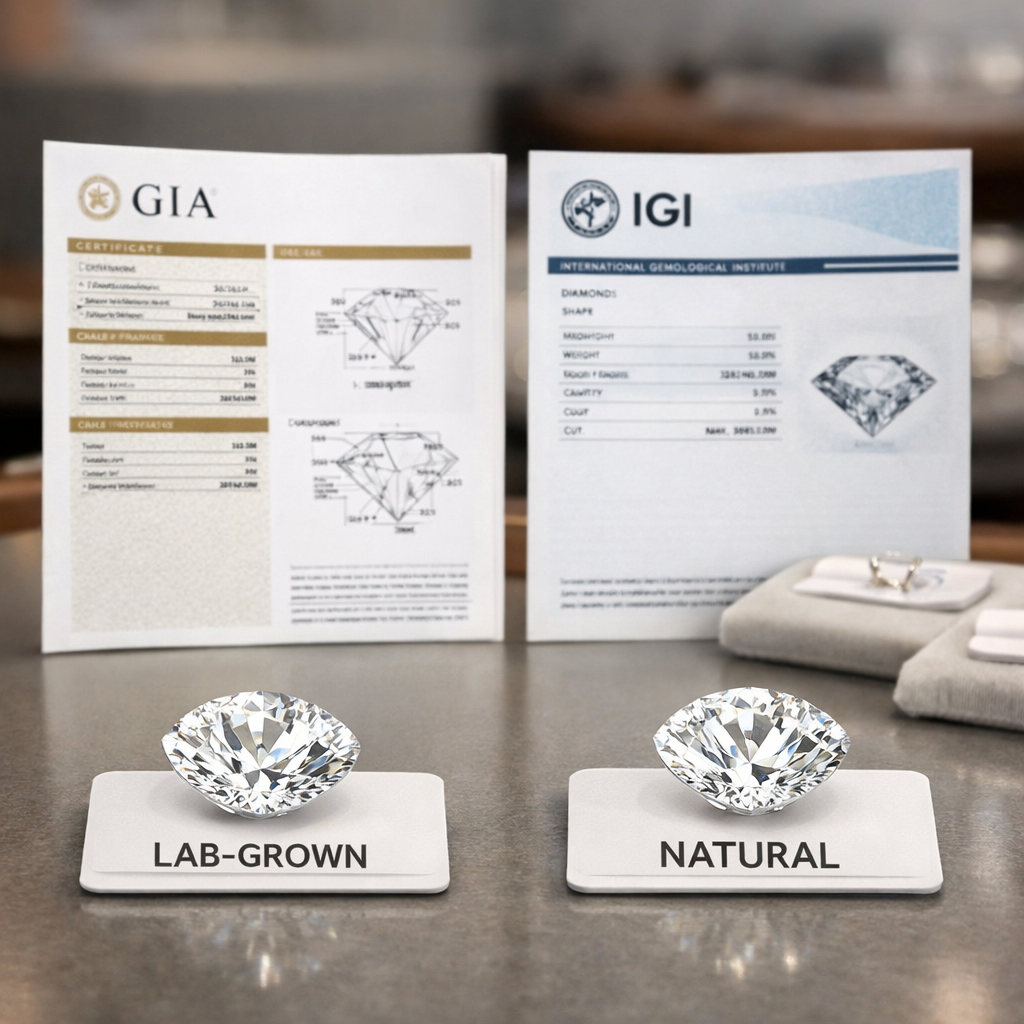
Choosing between GIA- and IGI-certified retailers comes down to verifiable grading, high-quality inspection tools, clear policies, and total-cost transparency. For both lab-grown and natural diamonds, start by confirming a third-party diamond grading report, checking the report number online, and reviewing 360° imagery before you buy. GIA is widely regarded as stricter on color, clarity, and cut, which can support resale confidence—especially for natural diamonds—while IGI is broadly adopted (particularly for lab-grown) with strong availability and competitive prices. Use Jewelry Guidebook’s checklists, table templates, and retailer-type guidance below to compare trusted diamond sellers efficiently and reduce risk.
How to compare retailers at a glance
Use Jewelry Guidebook’s quick-scan checklist for a diamond retailer comparison (lab-grown or natural):
- Certification and report access: GIA or IGI grading report shown on the product page with the report number.
- Imaging: High-resolution photos and 360° video, plus inclusion plots and precise measurements.
- Report verification: Direct links or guidance to verify the number on GIA/IGI websites.
- Policies: Clear return window, resizing, manufacturing warranty, and any upgrade/buyback terms.
- Services and settings: Setting quality, customization options, turnaround times.
- Total cost clarity: Stone, setting, taxes, shipping, insurance, maintenance—and any certification fees.
- Definition: A diamond grading report is a lab document describing the diamond’s 4Cs and identifying characteristics; it does not state market value or price (see Whiteflash’s explainer on IGI vs. GIA).
Jewelry Guidebook table template to compare trusted diamond sellers:
| Retailer | Certification focus | Inventory focus | Imaging tools | Report verification | Return window | Warranty | Upgrade/buyback | Typical price positioning |
|---|---|---|---|---|---|---|---|---|
| Example A | GIA | Natural | 360° video + photos | Direct GIA lookup link | 30–60 days | Lifetime manufacturing | Yes (natural) | Premium (often 5–15%) |
| Example B | IGI | Lab-grown | 360° video + photos | Direct IGI lookup link | 14–30 days | Limited | Varies | Value/competitive |
| Example C | Mixed (GIA/IGI) | Mixed | 360° + inclusion plots | On-page number + links | 30 days | Lifetime | Yes (policies vary) | Market-average |
A note for first-time shoppers: a diamond retailer comparison should prioritize the grading report, verifiable report numbers, and trustworthy imaging before everything else—this is the Jewelry Guidebook baseline.
GIA vs IGI grading essentials for shoppers
What changes between GIA and IGI grading—and why does it matter? GIA is widely recognized for conservative grading, especially on color and clarity, and for very strict cut standards where only the best-proportioned diamonds earn “Excellent,” shaping both pricing and downstream resale expectations (as noted in Leon Diamond’s comparison of GIA vs. IGI). IGI tends to be slightly more generous on cut and color, so an IGI Excellent cut may align to GIA Very Good in some cases; similar small shifts can occur in clarity. Differences vary stone-to-stone, but grading philosophy affects how a diamond is described and priced. Jewelry Guidebook’s guidance: verify any claimed grade alignment against the actual images, proportions, and inclusion plots.
Shared lab features: both GIA and IGI provide electronic reports with unique tracking numbers and often laser inscriptions you can verify online (outlined in Blue Nile’s guide to grading labs).
Side-by-side impacts on the 4Cs:
- Cut: GIA stricter; IGI often more generous on Excellent.
- Clarity: GIA conservative; IGI may read slightly higher (e.g., an IGI VS2 sometimes maps to a GIA SI1).
- Color: GIA evaluates under tight conditions; IGI can be more generous at the higher color grades.
- Carat: Carat weight is objective, but proportions and face-up size comparisons still matter for visual impact.
Criteria to vet trusted retailers
- Require visible third-party certification (GIA or IGI) and a report number you can verify on the lab’s site.
- Insist on robust inspection tools: 360° video, high-resolution images, inclusion plots, measurements, and fluorescence notes. For IGI-graded stones, ask for plot diagrams to cross-check that clarity grade expectations match what you see.
- Evaluate policies before payment: at least 30-day returns if possible, resizing details, manufacturing defects warranty, and whether they offer trade-in/upgrade or buyback (more common for natural diamonds). Request all-in pricing that includes stone, setting, taxes, shipping, insurance, and any certification fees.
Jewelry Guidebook’s bottom line: do not proceed without report verification and all key policies confirmed in writing.
Side-by-side evaluation by retailer type
Jewelry Guidebook evaluates retailer type by how well grading, imaging, and written policies align—brand names matter less than verifiable details.
GIA-certified natural diamond retailers
Positioning: Premium pricing, conservative grading, and strong resale recognition for buyers seeking long-term value.
- Considerations: Tighter tolerance on color/clarity, strict cut grading, and robust upgrade/buyback programs.
- What to verify: GIA report number and inscription, detailed proportions for cut quality, and written upgrade/buyback terms.
GIA-certified lab-grown diamond retailers
Positioning: Fewer sellers carry GIA-graded lab-grown, but these appeal to shoppers who want conservative grading aligned to natural benchmarks.
- Considerations: Helpful when precision on color/clarity is crucial and you want consistent grading standards across diamond types.
- What to verify: Report inscription, fluorescence details, inclusion plots, and the return and resizing policy.
IGI-certified natural diamond retailers
Positioning: Price-competitive with broad availability and many finished-jewelry options; buyers should cross-check grades carefully.
- Considerations: IGI grades both loose stones and finished jewelry with fast, affordable reports; adoption is wide across markets.
- What to verify: 360° imaging, inclusion plots, and the report number; understand that some jewelers may re-evaluate IGI stones using GIA standards, which can affect offers.
IGI-certified lab-grown diamond retailers
Positioning: IGI is prevalent for lab-grown, supporting quick availability and lower prices at mass-market and custom sellers.
- Considerations: Widely recognized across global markets; strong selection for budget-focused and everyday-wear shoppers.
- What to verify: Clear lab-grown origin disclosure, report number lookup, side-by-side media, plot diagrams, and return terms.
Pricing, value, and resale implications
Expect a price difference: many markets show a roughly 5–15% premium for GIA-graded diamonds with comparable 4Cs, reflecting stricter grading and market recognition (see Your Diamond Teacher’s analysis of GIA vs. IGI pricing). For natural diamonds, GIA’s conservative and globally recognized grading often supports stronger resale and trade-in outcomes; some buyers and jewelers re-evaluate IGI stones to GIA expectations, which can reduce offers. Certification fees are one component of total cost and may be higher with GIA, adding modestly to the final price (noted in Leon Diamond’s comparison). Jewelry Guidebook treats the GIA premium as a pricing context to weigh against your goals for precision, policies, and potential resale.
Remember: grading reports describe quality characteristics, not market value or price (as explained in Whiteflash’s explainer on IGI vs. GIA).
Inventory transparency and inspection tools
What you should see before you buy:
- Full grading report PDF (GIA or IGI) with the report number.
- High-resolution photos and 360° video.
- Proportions and measurements, inclusion plots, fluorescence notes.
- Laser inscription photos when available.
Jewelry Guidebook verification flow:
- Obtain the report number.
- Verify it on the GIA/IGI website.
- Match the laser inscription to the report.
- Review images and plots to confirm the grade makes sense visually.
- Confirm return, warranty, and upgrade policies in writing.
Both labs provide online report lookup tools and often laser inscriptions to help authenticate a stone (summarized in Blue Nile’s guide to grading labs).
Ethical sourcing and origin disclosure
Ask the seller to clearly label origin (natural or lab-grown) and disclose any treatments. IGI’s broad adoption for lab-grown and finished-jewelry reports makes origin and treatment disclosure straightforward for many retailers (see Diamondrensu’s overview of IGI vs. GIA). If a retailer makes environmental or ethical claims, request supporting documentation such as supplier statements or chain-of-custody information; Jewelry Guidebook encourages keeping copies with your receipt.
Policies, protections, and total cost of ownership
Insist on transparent protections:
- Return window (days) and any restocking fees.
- Resizing terms and costs.
- Manufacturing defects warranty.
- Trade-in/upgrade and, for natural diamonds, any buyback policy.
Use a total cost of ownership table:
| Cost item | Notes to capture |
|---|---|
| Diamond price | Certification included or extra? |
| Setting price | Metal, design, custom fees |
| Taxes and shipping | Shipping insurance coverage |
| Certification fees | Which lab? Fee included? |
| Maintenance | Rhodium plating, prong checks |
| Insurance | Annual premium estimate |
| Resizing/repairs | Terms and limits |
| Upgrade/buyback | Eligibility and formulas |
Note: Certification fees vary by lab, and GIA’s can be higher, modestly influencing the final price. Jewelry Guidebook recommends capturing these figures before checkout to avoid surprises.
Recommendations by buyer goal
- Tight color/clarity tolerance or long-term value: Prioritize GIA-graded inventory with excellent imaging and documented upgrade/buyback; budget for a 5–15% premium.
- Lower price or quick availability (especially lab-grown or finished jewelry): IGI-graded stones are common; verify images, plot diagrams, and the online report lookup.
- Everyday wear on a budget: IGI lab-grown often delivers strong value; confirm return/resizing and request laser inscription photos to match the report.
Frequently asked questions
Is GIA or IGI better for lab-grown diamonds?
Both certify lab-grown reliably; Jewelry Guidebook recommends choosing based on consistent grading, imagery, and clear policies.
How much price difference should I expect between GIA and IGI listings?
About 5–15% more for GIA-graded diamonds with comparable 4Cs, depending on size, cut quality, and market factors.
Do IGI grades run higher than GIA for the same diamond?
Often slightly; Jewelry Guidebook advises cross-checking an IGI grade against images and proportions, since GIA can be stricter.
Which certification matters most for resale value?
For natural diamonds, GIA typically has stronger resale recognition; Jewelry Guidebook suggests GIA if resale is a priority.
What documents should a trustworthy retailer provide before I buy?
A full grading report (GIA or IGI) with report number/laser inscription, high-resolution photos/360° video, inclusion plots, and clear return, resizing, warranty, and upgrade/buyback policies.