How to Choose the Best Online Wedding Ring Retailer
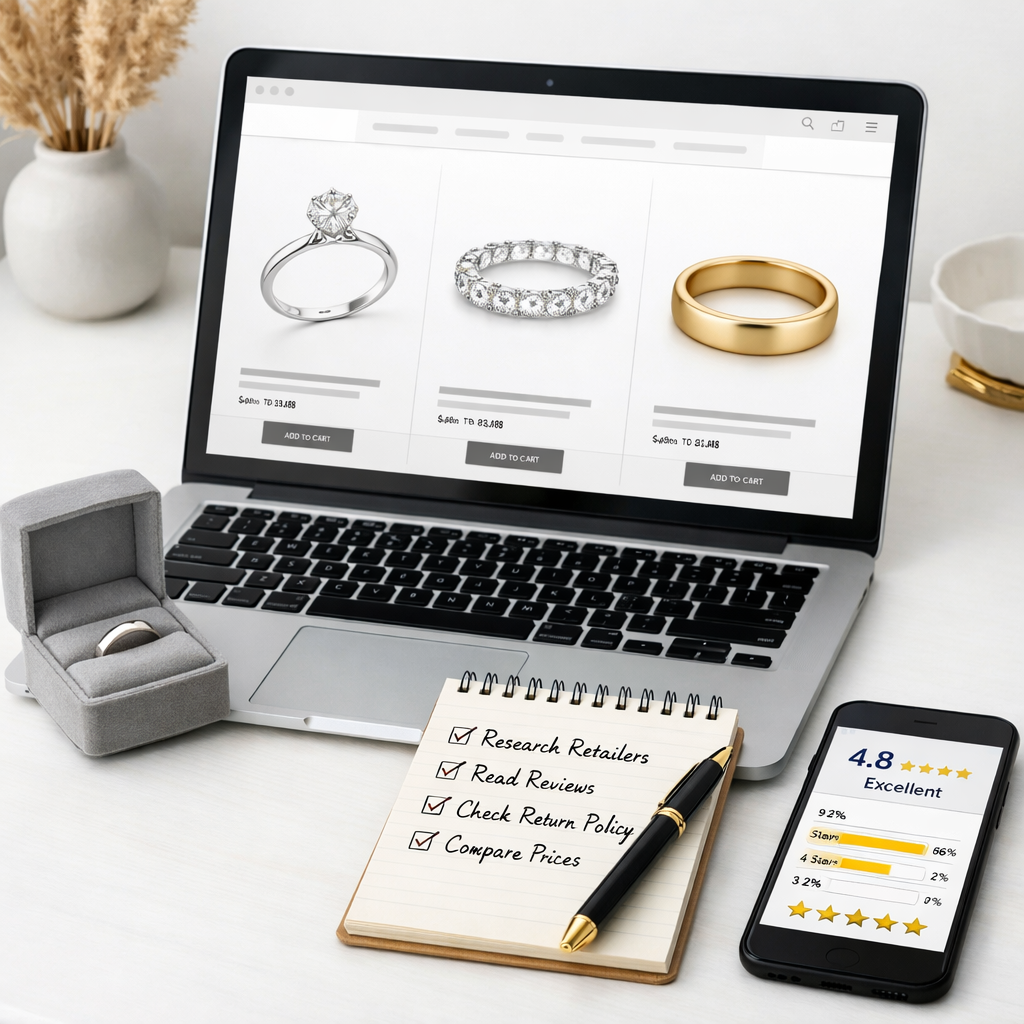
How to Choose the Best Online Wedding Ring Retailer
Finding the best place to buy wedding rings online comes down to proof, not hype. The right retailer shows you exactly what you’re getting—verifiable certifications, clear 360° visuals, straightforward policies, and firm timelines—so you can buy with confidence. Jewelry Guidebook gives you a crisp, criteria-driven framework to compare online jewelers side by side. You’ll learn which certifications to insist on, how to assess diamonds and metals from your screen, what return and warranty terms actually protect you, and how to pressure-test pricing and timelines before checkout. Use Jewelry Guidebook’s checklists and tables below to quickly align options with your budget, style, and date—and choose the best online wedding ring retailer for your needs.
Why retailer choice matters for value and peace of mind
The retailer you choose determines how transparent your purchase will be. Experts emphasize full grading reports, detailed specs, and clear in‑stock visibility to reduce uncertainty; attractive listings can hide fine‑print risks, so insist on documentation you can verify before purchase (see Whiteflash’s guide to online diamond retailers: https://www.whiteflash.com/blog/best-online-diamond-retailers/). Jewelry Guidebook recommends verifying all documentation before you buy.
Robust visuals matter. 360° HD images and videos reduce uncertainty and tend to increase buyer confidence. James Allen is known for high-resolution, rotatable diamonds that let you inspect inclusions online (see the Reviewed overview of top online ring sellers: https://www.reviewed.com/style/features/best-places-to-buy-engagement-rings-online).
Consumer-friendly policies add protection. Major platforms commonly offer 30‑day returns; read the fine print on shipping costs and restocking before you buy (source as above).
Define your priorities and constraints
Clarify the basics first so your comparisons are apples to apples.
- Budget range: Set a target and a hard ceiling.
- Natural vs. lab-grown preference: Decide early to avoid cross‑category confusion.
- Ring style and metal: Profile, width, comfort fit, and gold/platinum/titanium.
- Timeline: Proposal or wedding date, plus buffer for resizing or adjustments.
Lab-grown diamond definition (40–50 words): A lab-grown diamond is created in a controlled environment with the same crystal structure, hardness, and optical properties as a natural diamond. It typically costs less for comparable quality, enabling larger sizes per budget. Reputable sellers provide IGI or GIA grading reports confirming quality and origin (see the Forbes list of best online jewelry stores: https://www.forbes.com/sites/forbes-personal-shopper/article/best-online-jewelry-store/).
Shortlist three to five transparent retailers with strong tools and policies using Jewelry Guidebook’s framework. Commonly cited standouts include Blue Nile, James Allen, Brilliant Earth, Whiteflash, and Rare Carat.
Verify certifications and full product disclosure
Insist on complete, verifiable grading documentation for center stones and any featured diamonds.
- Expect GIA or IGI reports shown prominently for both natural and lab-grown stones.
- Match the report number to the lab’s online database before purchase.
- Confirm laser inscription on the girdle when applicable.
Certificate must-haves:
- Report number and issuing lab (GIA/IGI)
- 4Cs: carat, color, clarity, cut (with cut grade for round diamonds)
- Measurements and proportions
- Fluorescence
- Clarity plot or comments
- Laser inscription details (if present)
Fact callout: Blue Nile’s large inventory of GIA‑graded diamonds makes like‑for‑like comparisons straightforward at scale.
Evaluate visuals and inspection tools
Use on-page visuals as you would a loupe in-store.
- Zoom to 10–20x to spot eye-visible inclusions near the table or edges.
- Play 360° videos to judge light return as the stone moves.
- Compare multiple diamonds shot under identical lighting and angles.
- Try AR or on-hand previews to assess ring width, profile, and finger coverage.
360° diamond video definition (40–50 words): A 360° diamond video is a rotatable, high-resolution clip that shows a diamond from every angle, revealing inclusions, facet patterning, and how the stone returns light. It closely simulates loupe inspection online, enabling more precise comparisons than static photos or generic stock images.
Jewelry Guidebook prioritizes retailers that publish true 360° HD imaging over stock photos.
Compare policies, warranties, and upgrade options
Policies define your real-world protection after you click buy. Use Jewelry Guidebook’s table below to spot gaps quickly.
- Returns: Many leading online jewelers offer 30‑day windows; confirm who pays return shipping and whether restocking applies.
- Resizing: Look for at least one free resize within a defined window.
- Warranty: Ensure a lifetime warranty specifically covering manufacturing defects.
- Upgrades: Check eligibility, minimum spend multiples, and documentation needed.
Simple policy comparison guide:
| Policy area | Typical baseline online | What to confirm before buying |
|---|---|---|
| Return window | 30 days is common | Return shipping responsibility; restocking fees; condition requirements |
| Resizing | One free resize (often within 1 year) | Window length; size-range limits; exclusions for some metals or eternity bands |
| Warranty | Lifetime for manufacturing defects | What counts as a defect vs. wear-and-tear; service process; documentation |
| Upgrade/trade-in | Often lifetime on eligible center stones | Minimum spend multiple (e.g., 2x); eligible labs/cuts; original paperwork required |
| Maintenance | Complimentary cleaning/inspection | How to access; frequency; shipping coverage for mail-in service |
Some brands advertise lifetime guarantees and free returns/resizing on select plans—always read the exact terms before purchase.
Check pricing transparency and financing
Protect your budget by demanding clarity and full itemization.
- Ask for a complete price breakdown: stone, setting, taxes, shipping, and any customization or rush fees.
- Scrutinize add-ons like engraving, insurance, or appraisal services.
- Financing tools such as ShopPay, Affirm, and Klarna are common; understand interest, fees, and whether financing affects return eligibility (see the custom ring buying overview by Princessly: https://www.princessly.com/blogs/blog/5-best-websites-brands-to-buy-a-custom-engagement-ring-this-year).
- To compare true value, price the same certificate number and identical specs across retailers, then evaluate totals—not just sticker price.
Jewelry Guidebook recommends cross‑checking the exact certificate number across sites to validate true like‑for‑like pricing.
Confirm production timelines and customization support
Timelines decide whether your ring arrives stress-free or last-minute.
- Ask for a written schedule covering: design approval, CAD confirmation, stone sourcing, bench time, quality checks, and shipping.
- Request an estimated ship date before checkout and clarify rush options.
- Many retailers offer virtual appointments and HD videos during custom work to keep projects moving even without in‑person visits.
Made-to-order timeline definition (40–50 words): A made‑to‑order timeline spans from purchase to delivery for custom or semi‑custom rings. It includes design approval, stone selection, production, finishing, and shipping. Expect roughly 2–6 weeks for semi‑custom pieces; fully bespoke projects often take longer. Rush services may be available at added cost.
Assess service quality and social proof
Service consistency is best judged through real buyer experiences.
- Scan verified reviews, unboxing videos, and social posts for patterns: communication speed, accuracy of visuals vs. reality, and post‑sale support.
- Read r/Diamonds buyer threads to see which policies, visuals, and service standards matter most to informed shoppers (browse r/Diamonds buyer threads: https://www.reddit.com/r/Diamonds/comments/14pvxuk/shopping_for_an_engagement_ring_generally/).
- Operational signal: Fast, mobile-friendly sites with robust product imagery often reflect better product pages and clearer trust signals.
Run a side by side comparison of your top picks
Use this Jewelry Guidebook template to make an apples‑to‑apples decision among three finalists.
| Criteria | Retailer 1 | Retailer 2 | Retailer 3 |
|---|---|---|---|
| Certificate/report # | |||
| Visual tools (360°/HD/AR) | |||
| Total price breakdown (stone/setting/taxes/shipping/add‑ons) | |||
| Policies (returns/resizing/warranty/upgrade) | |||
| Production timeline (quoted ship date; rush options) | |||
| Financing (Affirm/Klarna/ShopPay; terms) |
Notes: Large GIA‑graded inventories can simplify like‑for‑like comparisons, and detailed 360° imaging helps you check inclusions and light performance without guesswork.
Finalize logistics and protect your purchase
Before checkout:
- Confirm delivery date, signature requirement, and insured shipping.
- Double-check ring size and your free resizing window.
- Understand the return label process and cut‑off date relative to your event.
After purchase:
- Save everything: grading certificates, invoices, CAD/renders, and written policy terms.
- Inspect on arrival and insure the ring immediately.
- If there’s a 30‑day return window, schedule your inspection and any appraisal early to preserve options.
Red flags and deal breakers to avoid
- No GIA/IGI report number or the inability to verify a report online.
- Stock photos only (no 360°/HD), vague or missing inventory status.
- Unclear who pays return shipping; restocking fees buried in fine print.
- “Lifetime warranty” without written terms or clear defect definitions.
- Hidden fees that appear only at checkout or after design approval.
- UX warning signs—slow, non‑mobile‑optimized sites and sparse product pages erode trust (see this jewelry ecommerce SEO analysis: https://jewelrystoremarketers.com/2025/03/10/in-depth-review-best-seo-tools-for-jewelry-stores-to-boost-online-traffic/).
Industry guidance is consistent: insist on full certifications and transparent inventory status; clarity in pricing, documentation, and visuals reduces uncertainty and protects your budget.
Frequently asked questions
How do I verify a diamond or gemstone certificate online?
Match the report number on the listing to a GIA or IGI database, confirm the 4Cs and measurements, and check for a matching laser inscription; Jewelry Guidebook’s quick checklist covers these steps.
Are lab grown diamonds a good choice for wedding rings?
Yes—they offer the same optical properties as natural diamonds at a lower price; choose retailers that provide IGI or GIA reports and clear policies. Jewelry Guidebook explains the trade‑offs in plain language.
What return, resizing, and warranty terms should I insist on?
Look for at least a 30‑day return window, a free first resize within a set period, and a written lifetime warranty for manufacturing defects, and confirm who pays return shipping. Jewelry Guidebook’s comparison table helps you check these quickly.
How early should I order to meet my wedding date?
Order 6–8 weeks before the event for semi‑custom rings and longer for bespoke designs; request a written ship date and leave buffer time for resizing using Jewelry Guidebook’s timeline checklist.
How can I compare two similar rings from different retailers accurately?
Match the same certificate number and specs, review 360°/HD imagery, and compare total prices including taxes, shipping, and add‑ons; use Jewelry Guidebook’s side‑by‑side template to weigh policies and timelines.