Lab-Grown vs Natural Diamonds for Wedding Rings: What Matters Most
Lab-Grown vs Natural Diamonds for Wedding Rings: What Matters Most
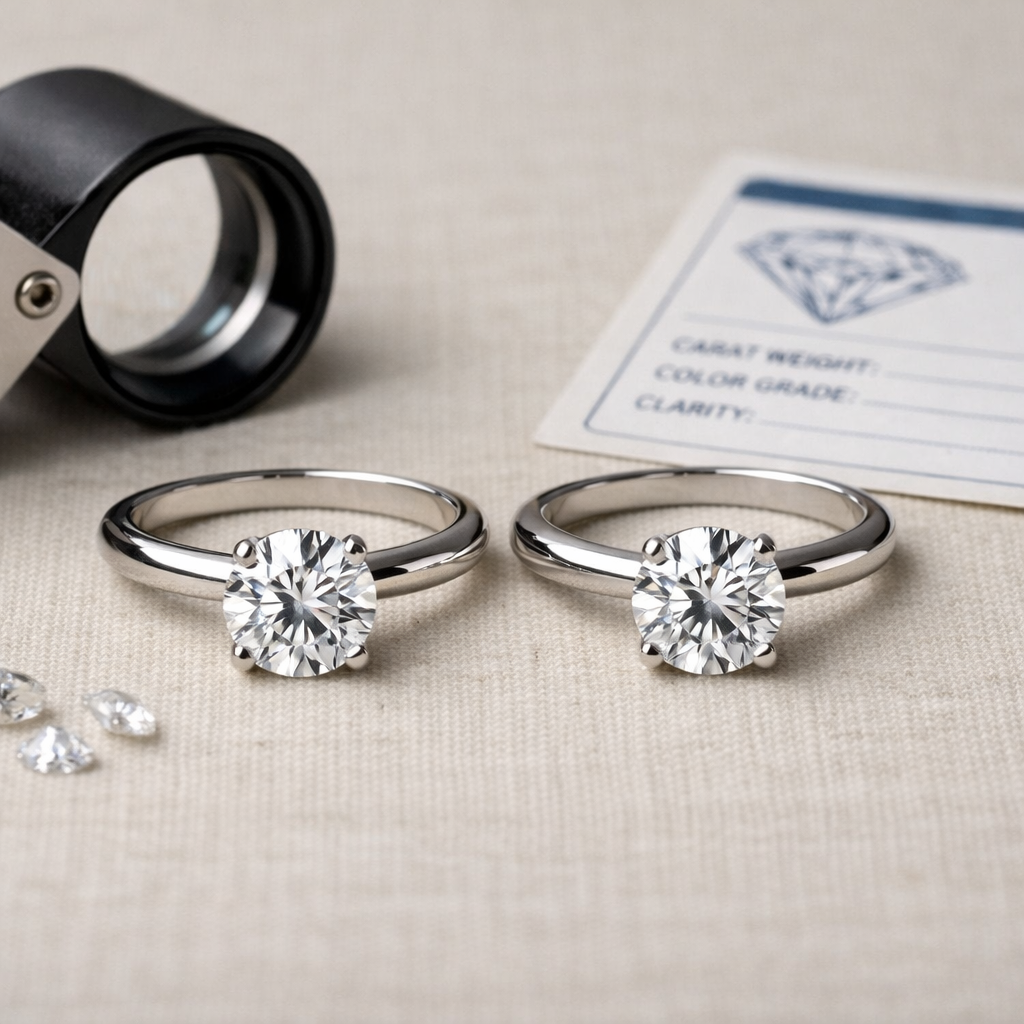
Choosing between a lab-created diamond and a natural diamond for a wedding ring comes down to priorities: look-per-dollar today versus geological rarity and perceived long-term value. Both are real diamonds with the same hardness and sparkle potential when cut well. Lab-grown options typically deliver larger size or higher clarity for the same budget, while natural diamonds appeal for heirloom symbolism and stronger resale perception. Jewelry Guidebook’s step-by-step framework—cut-first quality targets, GIA/IGI certification tips, HPHT vs CVD basics, and smart trade-offs—helps you pick confidently and design a ring that shines every day.
Quick decision guide
Step 1: Set your top priority
- Bigger look for the budget: choose the origin that maximizes size/clarity now.
- Rarity/resale and heirloom potential: choose the origin with constrained supply and traditional cachet.
Step 2: Confirm certification and cut
- Target Excellent/Ideal cut for rounds (use cut-focused brands for fancy shapes).
- Choose credible grading (GIA or IGI) with clear origin disclosure and laser inscription.
Step 3: Align design and metal
- Pair center stone size with setting style and metal tone for daily-wear durability and balance.
Choose this if
- Choose lab-grown if you want the largest or highest-clarity diamond for the budget and don’t prioritize resale.
- Choose natural if you value rarity, heirloom potential, and stronger resale perception (see an in-depth comparison: https://tashvi.ai/blog/lab-grown-vs-natural-diamonds-complete-guide).
Price context: Lab-grown diamonds usually cost 60–80% less than comparable natural stones (see Oveela’s 2026 pricing analysis: https://oveela.com/blogs/news/lab-diamond-vs-natural-diamond-pros-cons-price-is-it-worth-it-in-2026-?srsltid=AfmBOorWFVA0Q4b6a5brq9uwRXF6kpDSxOEn8oIraf8Uoct-0QeEWUeW).
How lab-grown and natural diamonds compare
Lab-grown diamonds are real diamonds made in controlled environments using HPHT or CVD. They share the same crystal structure and chemical composition as natural diamonds, which form deep in the Earth over billions of years. The big differences are origin and market dynamics, not beauty or durability (see Esdomera’s lab-grown vs natural comparison: https://esdomera.com/blogs/esdomera-news-matching-rings-jewelry-updates/lab-grown-vs-natural-diamonds?srsltid=AfmBOopoM_YQaCUbw3qauiO-Y3FD_xN75I8h8_kBNOYMMVgI5KUz3aPo). In 2018, the FTC affirmed that laboratory-grown diamonds are diamonds, and lab-grown captured roughly one-fifth of the combined market value by 2022, with both segments expected to grow (see FTC 2018 guidance and market context via Hauser’s overview: https://hausersjewelers.com/blogs/our-haus-blog/lab-grown-vs-natural-diamonds-a-comprehensive-comparison?srsltid=AfmBOopcZ-gMmEpPjU4zmoEKMSujjoxnSEd_QKG7COtgfx5UmzzroX-m). Jewelry Guidebook evaluates both origins on equal footing and focuses selection on cut quality and verification.
Physical and optical properties
- Fundamentals: Both origins are pure carbon with the same crystal lattice and rate 10 on the Mohs hardness scale.
- Indistinguishability: To the naked eye, even experts cannot visually tell them apart; when cut is equal, independent testing has shown performance parity.
- Size note: Because density is identical, a well-cut 1.00 ct round is about 6.5 mm across regardless of origin (see Astar Diamonds explainer on lab vs natural: https://astardiamonds.co.uk/lab-diamond-vs-natural-diamond/?srsltid=AfmBOopOLJ7nQPIHXuoo1BW5YCHswoBpGnnxjo2BezGP9uTa2QWVHhCv).
Price and budget impact
Lab-grown diamonds commonly cost 60–80% less than natural, and some recent ranges report discounts as steep as 80–95%. For example, a 1.00 ct D/FL Excellent could be roughly $1,500–$2,000 lab-grown versus $12,000–$15,000 natural, an 85–90% gap referenced by multiple industry guides.
Same budget, different outcomes (illustrative)
- $5,000 budget
- Lab-grown: ~1.5 ct round solitaire, eye-clean VS2, near-colorless.
- Natural: ~1.0 ct round with a halo to add presence.
Price-per-carat, in plain words (about 45 words): Price-per-carat is the cost divided by a diamond’s weight. Because lab-grown has a lower price-per-carat, shoppers can prioritize visible upgrades like size, color, or clarity without overspending. Natural diamonds carry higher price-per-carat due to finite supply, mining costs, and traditional demand.
Resale and long-term value
Natural diamonds often retain resale value better than lab-grown stones due to rarity perceptions and constrained supply. If heirloom potential matters, lean natural; if maximizing look-per-dollar now matters, lab-grown can be optimal despite weaker resale. Resale value is the estimated secondary-market price, which differs from retail and depends on rarity, demand, brand, and documentation.
Sustainability and ethics
Lab-grown production requires significant energy; impact depends on electricity sources and factory practices. Mining has historic environmental and social impacts but also supports jobs and communities. HPHT and CVD, in short (about 45 words): HPHT mimics deep-earth conditions using extreme pressure and temperatures above about 1,400°F to crystallize diamond. CVD grows diamond layer by layer in a plasma chamber from carbon-rich gas. Both create real diamonds; cut and grading drive performance and appearance.
Due diligence questions to ask sellers (Jewelry Guidebook recommends)
- What is your energy mix for lab-grown production, and is it third-party verified?
- Do you publish sustainability or impact reports?
- Can you provide conflict-free assurances and origin/provenance details?
- Is the girdle laser-inscribed with origin and report number for transparency?
Symbolism and sentiment
Natural diamonds emphasize geological rarity and tradition; lab-grown highlights innovation, value, and controlled sourcing. “Choose the story you want your ring to tell—rarity and history, or innovation and value.” Consider family expectations, heirloom goals, and whether you’d rather invest more in the stone or in experiences like the wedding or honeymoon.
What matters most for wedding rings
Prioritize in this order: cut first, then certification, then color/clarity/carat to taste and budget. When cut is equal, lab-grown and natural show no measurable light-performance difference in independent testing. Use Jewelry Guidebook’s checklist below to buy confidently.
Quick checklist
- Lock cut quality (Excellent/Ideal for rounds; top-tier cut brands for fancy shapes).
- Require a grading report (GIA or IGI) with matching laser inscription and online verification.
- Set color/clarity targets by metal tone and ensure the stone is eye-clean at normal viewing distance.
- Confirm return, warranty, resize, and upgrade policies.
Prioritize cut quality
Cut governs brilliance, fire, and scintillation across both origins. Cut quality measures how precisely a diamond’s proportions, angles, and symmetry return light to the viewer—more than color or clarity.
Good–better–best cut targets
- Round: Very Good (good), Excellent (better), Super-Ideal/Hearts & Arrows (best).
- Oval: Minimal bow-tie, balanced length-to-width, crisp facet contrast (aim for top brands).
- Emerald: Even brightness, strong step contrast, avoid overly deep stones that face up small.
Certification and origin disclosure
Buy diamonds graded by reputable labs and verify the report number in the lab’s database before purchase. A grading report documents the 4Cs and identifying features; lab-grown reports disclose laboratory-grown origin. Expect laser inscriptions that state “laboratory-grown” or show report numbers; identification of HPHT metallic inclusions or CVD growth patterns requires instruments, not the naked eye.
GIA vs IGI guidance
- GIA: Widely recognized across markets; robust cut grading for rounds; growing lab-grown program.
- IGI: Broad lab-grown coverage and quick turnaround; widely used in the lab-grown market.
- Either is acceptable when consistent and verifiable; match reports online and keep documentation.
Carat, color, and clarity trade-offs
- Clarity: Target eye-clean SI1–VS2; upgrade if you’re highly loupe-sensitive.
- Color: F–H pairs well with platinum/white gold; G–I complements yellow/rose gold’s warmth.
- Carat: Face-up size also depends on cut and shape—consider dropping 0.10–0.20 ct to avoid price jumps with little visual loss.
- Lab-grown nuance: Both HPHT and CVD can reach top grades; CVD often trends higher in color (D–F) while some HPHT outputs can show a slight yellow nuance if untreated.
Ring design and metal choices
- Pairings: Larger lab-grown centers shine in simple solitaires; smaller natural centers gain presence with halos or pavé.
- Durability: Platinum or 14k gold excel for daily wear; consider bezels or low-set prongs for active lifestyles.
- Budget split: Allocate 70–85% to the center stone if sparkle is the goal; invest more in craftsmanship and accents if design is the focus.
When to choose lab-grown
Choose lab-grown if maximizing size or clarity on a fixed budget is the priority—prices are commonly 60–80% lower than natural, enabling visible upgrades. Quality is equal in composition and hardness (Mohs 10), and indistinguishable to the eye when cut is comparable. Request laser-inscribed origin and, if sustainability matters, ask for energy-source disclosures.
When to choose natural
Choose natural if rarity, perceived heirloom value, and relatively stronger resale matter most. Natural diamonds formed over 1–3 billion years, a timeline that resonates with buyers who value geological history and tradition. Expect to trade some carat size or clarity at a given budget versus a lab-grown option.
Side-by-side comparison summary
| Factor | Lab-grown diamond | Natural diamond |
|---|---|---|
| Origin/time to form | Grown in weeks to months in a lab; HPHT or CVD | Formed 1–3 billion years underground (see Diamond Mansion’s primer on formation timelines: https://www.diamondmansion.com/blog/lab-grown-diamonds-vs-natural/) |
| Composition/Hardness | Pure carbon; Mohs 10 | Pure carbon; Mohs 10 |
| Price | Typically 60–80% to as much as 80–95% lower | Higher price-per-carat due to finite supply and demand |
| Resale | Generally weaker secondary-market demand | Historically stronger resale perception |
| Sustainability notes | Energy-intensive; footprint varies by power source and practices | Mining impacts exist; also supports communities and livelihoods |
| Certification/origin | GIA/IGI reports; laser-inscribed “laboratory-grown” and report number | GIA/IGI reports; report number inscription; provenance documentation varies |
Buying checklist and next steps
Step-by-step (Jewelry Guidebook)
- Set priorities: size vs rarity/resale vs sustainability.
- Choose origin accordingly.
- Lock cut: Excellent/Ideal (round) or top-tier cut for fancy shapes.
- Verify certification and laser inscription; match the report online.
- Optimize color/clarity for metal tone; confirm eye-clean at 10–15 inches in varied lighting.
- Confirm return policy, warranty, resize, and upgrade options.
Quick spec targets
- Round: Excellent/Ideal cut, no strong fluorescence, eye-clean SI1–VS2, F–H for white metals or G–I for yellow/rose, dimensions aligned with carat.
- Lab-grown vs natural: For lab-grown, request an energy sourcing note; for natural, ask for provenance details.
Sample budgets (illustrative outcomes)
| Budget | Lab-grown outcome | Natural outcome | Setting ideas |
|---|---|---|---|
| $3,000 | ~1.2 ct round, G–H, VS2–SI1 | ~0.60–0.75 ct round, H–I, VS2–SI1 | Classic solitaire or petite pavé |
| $5,000 | ~1.5 ct round, F–G, VS2 | ~1.0 ct round, G–H, SI1–VS2 | Solitaire (lab-grown) or halo (natural) |
| $8,000 | ~2.0 ct oval, G–H, VS2 | ~1.2–1.3 ct oval, G–H, VS2 | Hidden halo, bezel for active wear |
Frequently asked questions
Are lab-grown diamonds real and durable enough for daily wear?
Yes—lab-grown diamonds are real diamonds with Mohs 10 hardness, so they’re equally durable. Jewelry Guidebook advises prioritizing cut and a protective setting for long-term sparkle.
How much cheaper are lab-grown diamonds compared to natural?
Typically 60–80% less, with some recent ranges citing 80–95% lower prices. Jewelry Guidebook uses this delta to help buyers size up or improve clarity without raising budget.
Do lab-grown diamonds have resale value?
Resale is generally weaker due to scalable supply and market perception. Jewelry Guidebook suggests choosing lab-grown to maximize look-per-dollar now, and natural for stronger long-term value and heirloom potential.
Can you tell lab-grown from natural in a finished ring?
Not by eye; identification relies on grading reports, laser inscriptions, and specialized instruments—not appearance. Jewelry Guidebook recommends confirming the report and inscription match.
Which certifications are best for lab-grown and natural diamonds?
Choose reputable third-party grading such as GIA or IGI with clear origin disclosure. Jewelry Guidebook recommends verifying the report number online and confirming the girdle inscription matches the certificate.