Online vs Local: Best Places to Buy Loose Diamonds Compared
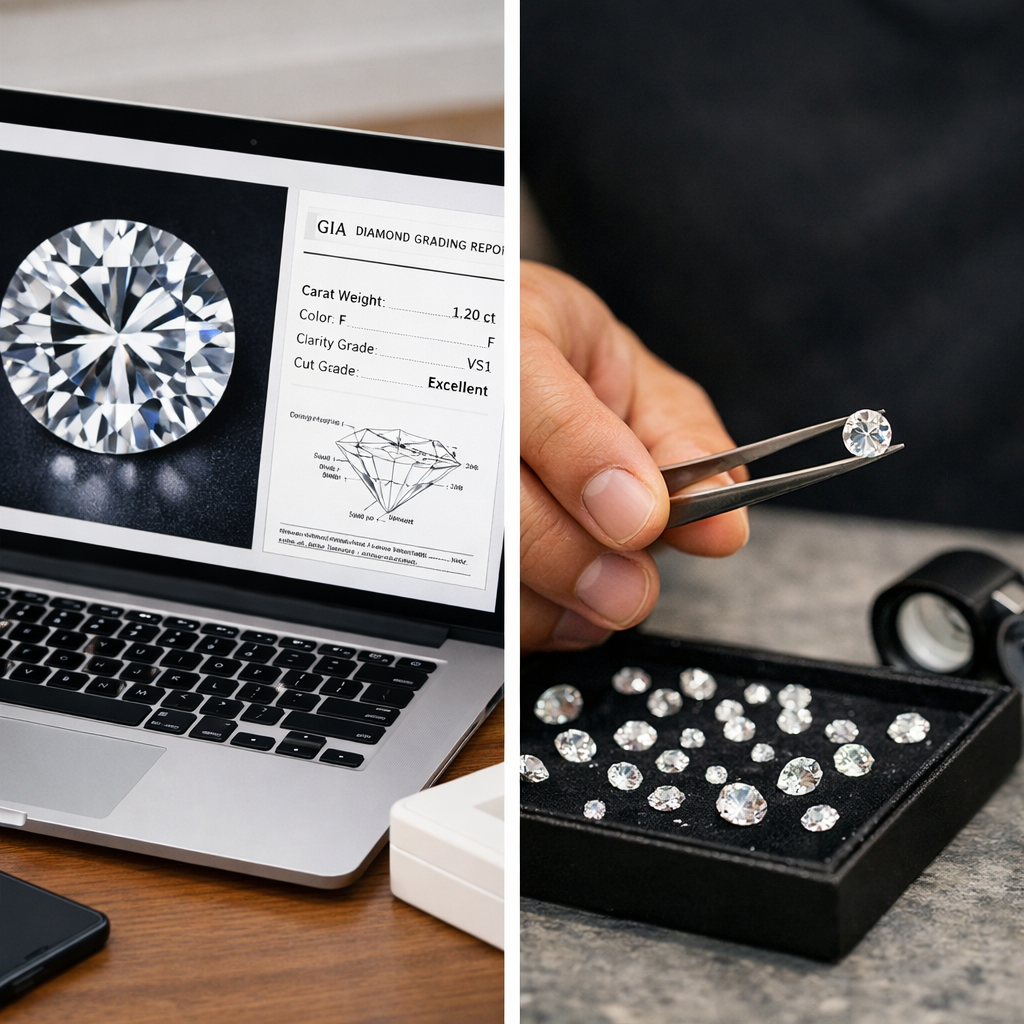
Online vs Local: Best Places to Buy Loose Diamonds Compared
Choosing the best place to buy loose diamonds comes down to what you value most: lowest price and selection, or hands-on inspection and service. Online marketplaces let you buy loose diamonds with powerful filters, dynamic pricing, and vast inventories. Local jewelers offer in-person viewing, negotiation, and long-term aftercare. At Jewelry Guidebook, our bottom-line take: start online to benchmark specs, pricing, and certification; then confirm details and your setting plan with a reputable local bench before you commit.
Quick takeaways
- Online generally wins on price due to aggregated inventory and dynamic pricing; local stores may list higher but can bundle value (setting, sizing, aftercare) and sometimes negotiate.
- In-person inspection at a local jeweler reduces uncertainty with loupes, lighting comparisons, and real-time expert guidance.
- Make diamond certification non-negotiable (e.g., GIA/AGS/GCAL; IGI commonly seen for lab-grown). Always verify report numbers and laser inscriptions.
- Expect clear, time-limited returns online; local shops often offer flexible adjustments and relationship-based aftercare.
- Reputation matters: 98% of consumers consult reviews and 94% trust them as much as personal recommendations, underscoring the role of recent, consistent feedback [source: https://whitespark.ca/blog/7-local-search-ranking-factors-that-may-challenge-your-current-thinking/].
- One-line plan: start online for selection and price discovery; validate grading and setting logistics with a trusted local jeweler. Use Jewelry Guidebook’s checklists below to stay organized.
How we compare online and local diamond sellers
We evaluate price and volatility, selection and sourcing, trust and certification, inspection experience, returns/warranty/aftercare, and reputation signals.
Dynamic pricing is a strategy where sellers adjust prices in near real time based on demand, competition, and inventory. Software ingests sales and market signals to optimize prices, sometimes predicting spikes and surfacing discounts. Buyers may see fluctuating offers, seasonal promos, and short-lived deals [source: https://www.uschamber.com/co/run/finance/dynamic-pricing-strategies-and-tools].
Jewelry Guidebook is retailer-agnostic. We compare total value (price + policies + service) with transparent methods and independent verification steps, and we publish checklists you can apply anywhere.
Price and value
Online prices often reflect real-time algorithmic changes, flash promos, and marketplace competition. Monitoring tools can track shifts—just ensure your tool syncs with current listings for accuracy [source: https://www.uschamber.com/co/run/finance/dynamic-pricing-strategies-and-tools]. Some paid trackers start around $25/month; Octoparse, for example, has a free plan with paid tiers from roughly $69/month [source: https://prisync.com/blog/16-best-competitive-pricing-tools-in-2026-pros-cons/].
Local jewelers may start higher on sticker price, but they can negotiate and frequently include bundled services (custom setting, complimentary sizing, future prong checks, and periodic cleaning) that reduce lifetime costs.
Value stack: compare beyond sticker price
| Cost Component | Online | Local |
|---|---|---|
| Sticker Price | Often lower, dynamic promos | Often higher list, room to negotiate |
| Shipping/Insurance | Usually included outbound; return may be extra | N/A if picked up; delivery may add |
| Setting/Labor | Priced separately; outsource locally if needed | Often bundled or discounted with stone |
| Resizing | Fee-based post-purchase | Commonly included once |
| Warranty | Written, limited duration | Relationship-based, often flexible on maintenance |
| Appraisal | Sometimes available or via partner | In-house or recommended appraiser |
| Return Shipping | Buyer may pay and insure | Often not applicable; exchanges more common |
| Time Cost | Research/coordination time | Store visits; faster decisions with guidance |
Tip: Compare “total cost to own” over the first 12 months, not just the listing price. Use Jewelry Guidebook’s Total cost checklist below to capture the full picture.
Selection and availability
Online platforms aggregate global inventories with standardized filters across the 4Cs and show grading reports, videos, and images in one place. It’s the fastest route to find specific specs or rare combinations, and top vendors offer rich media and education to guide choices [source: https://www.jamesallen.com/education/diamonds/].
Local jewelers excel at immediate viewing, curated gems, and on-the-spot setting advice. They may also have unique estate pieces or stones on memo that don’t surface online—ideal for same-day decisions or tactile reassurance.
Specialty segments to target:
- Fancy shapes (oval, emerald, marquise, pear)
- High-color, high-clarity stones
- Ideal-cut rounds (hearts-and-arrows tiers)
- Antique cuts (Old European, Old Mine)
- Matched pairs for earrings
Inspection and buying experience
Local jewelers provide hands-on loupe viewing, different lighting environments, and live comparisons—especially useful for first-time buyers learning how cut performance affects sparkle.
Online leaders pair detailed listings with high-res photos, 360° videos, virtual appointments, and knowledgeable support teams. Many standardize imaging (e.g., ASET/IdealScope) to evaluate light return and leakage before you buy [source: https://www.whiteflash.com/diamond-education/].
AI-assisted support uses machine learning to help customer service teams triage questions, summarize conversations, suggest answers, and automate routine steps. It improves responsiveness and consistency across chat, email, and phone—mimicking in-store expertise at scale for online shoppers [source: https://www.gorgias.com/blog/zendesk-features].
The steps below mirror how we evaluate stones for readers at Jewelry Guidebook. Side-by-side review steps:
- In person: view under daylight/LED/jeweler’s lamp, loupe to 10x, compare two to three candidates side-by-side, confirm eye-cleanliness and fire/scintillation, discuss setting compatibility.
- Online: examine photos/360° video, review proportions and images (ASET/IdealScope when available), confirm return terms and insured shipping, and schedule a virtual consult if unsure.
Certification and verification
Independent diamond certification is essential. Prioritize grading from GIA, AGS (now integrated with GIA’s cut research), or GCAL; IGI is widely used for lab-grown stones. Always verify the report number on the lab’s website and match it to the laser inscription on the girdle [source: https://www.gia.edu/report-check-landing]. Then follow Jewelry Guidebook’s verification flow below.
Verification flow:
- Obtain the grading report.
- Match specs to the listing and invoice.
- Validate the report on the lab’s website.
- Inspect the laser inscription with a loupe.
- Confirm measurements/proportions and fluorescence.
- Get an independent appraisal before setting.
- Store digital copies for insurance.
For cut-first guidance and the 4Cs, review neutral tutorials from respected educators [source: https://www.diamonds.pro/education/], and use the checklists in this guide to apply what you learn.
Returns, warranty, and aftercare
Online, expect time-limited returns (often 14–30 days). Clarify whether return shipping is insured, who pays, any restocking fees, and whether a quality inspection occurs before refunds. Use the checklist below to compare policies.
Locally, return policies vary, but you often gain flexible resizing, routine cleaning, prong checks, and relationship-driven service that adds long-term value.
Checklist to review:
- Return window and authorization steps
- Return shipping and insurance coverage
- Any restocking or inspection fees
- Workmanship warranty length and terms
- Maintenance schedule (cleaning, tightening, inspections)
- Resizing policy and timelines
Trust signals and reputation
Shoppers rely heavily on reputation: 98% consult reviews and 94% trust them at near word-of-mouth levels; buyers generally prefer average ratings of at least three stars, and nearly half spend more time reading reviews year over year [source: https://whitespark.ca/blog/7-local-search-ranking-factors-that-may-challenge-your-current-thinking/].
Scan recent reviews for:
- Certification and report verification experiences
- Return/refund handling and transparency
- Aftercare responsiveness (resizing, repairs, cleanings)
- Clarity of communication and policy consistency
Also verify business details on-site, read policy pages end-to-end, and call to test responsiveness.
Online marketplaces
Benefits include vast selection, robust 4Cs filters, visible grading reports, and competitive pricing—features that make them frequent picks in expert roundups [source: https://www.forbes.com/vetted/article/best-places-to-buy-diamonds-online/].
Risks include price volatility and short-lived deals. Use monitoring tools and ensure your data is synced and current to avoid stale prices [source: https://www.uschamber.com/co/run/finance/dynamic-pricing-strategies-and-tools].
Mini-checklist:
- Verify certification and laser inscription
- Confirm return window and restocking terms
- Use insured, trackable shipping
- Review high-resolution media carefully
- Arrange an independent appraisal post-delivery
Online wholesalers and discount platforms
Lower markups and warehouse-scale access can surface below-retail pricing, but you must lean on paperwork and policies when you can’t see stones in person.
Before buying, confirm:
- Clear grading reports and verification process
- Return window, shipping insurance, and who pays
- Support-channel maturity (automations, intent detection, and quick-response workflows are good reliability signals) [source: https://www.gorgias.com/blog/zendesk-features]
If visual data is limited, choose conservatively on cut parameters and maintain a no-questions-asked return option.
Local independent jewelers
Independents shine with personalized service, side-by-side comparisons, custom designs, and immediate aftercare. They’re ideal for translating your vision into a practical setting plan and for long-term maintenance.
Vet by reading recent community reviews, asking to view multiple stones under varied lighting, and requesting comparisons across cut qualities and shapes. Nearly all consumers consult reviews before picking a local business—use that to your advantage.
Local chain jewelers
Chains offer standardized policies, nationwide warranties, predictable processes, and financing options. Selections per store can be narrower, customization may be limited, and prices less dynamic.
Ask for full certification details, compare against online price baselines for similar specs, and confirm what services (resizing, cleanings, inspections) are included in writing.
Estate and auction dealers
Estate and auction sources can deliver one-of-a-kind antique cuts, period settings, and value for buyers open to restoration or resetting.
Demand rigorous documentation. Require lab confirmation for center stones, understand reserve/hammer price dynamics, and secure preview or strict return terms.
Due diligence:
- Provenance and condition report
- Independent lab grading or pending submission
- Reserve/hammer price awareness with buyer’s premium
- Post-purchase restoration or reset plan and costs
When to buy online vs when to buy local
Use this quick map of goals to channels:
| Buyer Goal | Best First Stop |
|---|---|
| Lowest possible price | Online |
| Rare specs/shapes | Online |
| Rush timelines | Local |
| Custom design | Local |
| Hands-on guidance | Local |
| Maximum privacy/anonymity | Online |
Total cost checklist before you buy
Account for every line item with Jewelry Guidebook’s checklist:
- Stone price and sales tax
- Shipping and insured return shipping
- Setting and labor
- Resizing (initial and future)
- Independent appraisal
- Insurance rider for jewelry
- Maintenance (cleaning, prong checks)
- Warranty coverage and exclusions
- Potential restocking or inspection fees
- Time cost (research, consultations)
Track price movements with tools; entry plans start around $25/month, and Octoparse has a free tier with paid options from roughly $69/month. Confirm any pricing calculator syncs properly with live data for accuracy.
How to verify a loose diamond
Use this Jewelry Guidebook step-by-step flow:
- Get the grading report or report number.
- Match report specs to the listing and invoice.
- Verify on the lab’s website.
- Loupe the laser inscription to confirm identity.
- Check measurements, proportions, and fluorescence.
- Obtain an independent appraisal before setting.
- Store digital copies for insurance and future claims.
If details don’t match: pause, contact the seller immediately, and use the return window.
Our recommendation by buyer profile
- First-time engagement buyer: Start online for selection and pricing; shortlist two to three stones, then validate details locally before setting. Prioritize cut quality and return terms.
- Custom ring seeker: Begin with a local independent for design, ergonomics, and aftercare; consider sourcing the stone online if specs are scarce.
- Value-maximizer: Shop online with price tracking and alerts; insist on top-tier certification and a clean return policy; confirm with an independent appraisal.
- Heirloom/antique enthusiast: Target estate/auction sources, but require lab confirmation and expert guidance with strict preview/return terms.
Frequently asked questions
Is buying loose diamonds online cheaper than locally?
Online listings often run lower due to aggregated inventory and dynamic pricing, but local jewelers can bundle services and negotiate. Compare total cost using Jewelry Guidebook’s checklists, not just sticker price.
How do I make sure a loose diamond is authentic?
Buy stones with independent lab reports, confirm the report online, and match the laser inscription. Then get an independent appraisal before setting; Jewelry Guidebook’s verification flow walks you through it.
What is the safest return and shipping process for loose diamonds?
Use insured, trackable shipping with clear return authorization, and confirm who bears risk in transit. Jewelry Guidebook’s return checklist helps you photograph contents, keep paperwork, and ship early within the window.
Should I buy lab-grown or natural for best value?
For upfront savings, lab-grown typically costs significantly less than comparable natural stones. If long-term rarity or traditional appeal matters most, natural may be preferable despite higher prices; Jewelry Guidebook’s guides outline the trade-offs.
Can I negotiate price with local jewelers or online sellers?
Local jewelers often allow negotiation or bundled value on settings and services. Online prices are more dynamic; instead of haggling, watch for promotions or use price alerts to time your purchase with the tips in this guide.