Top 10 Sites for Colored Lab-Grown Diamonds Online in 2026
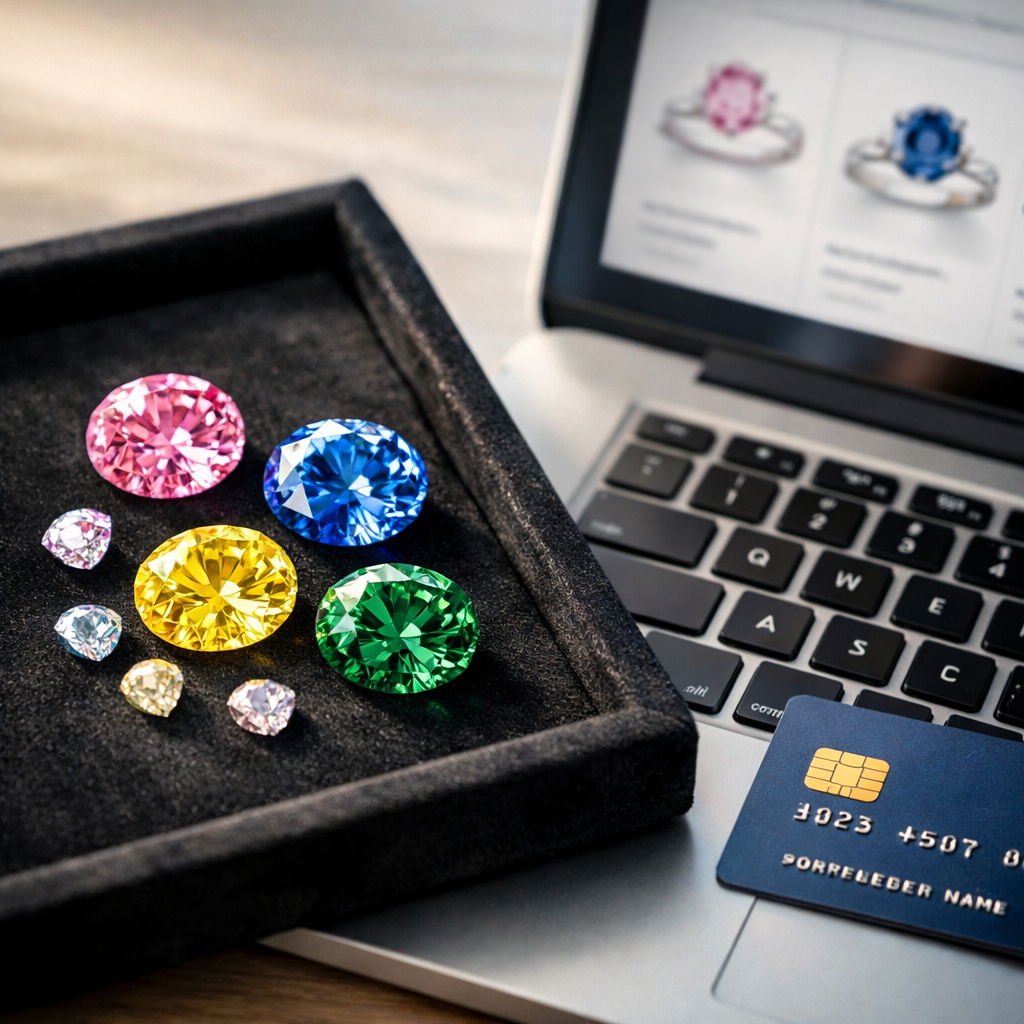
Top 10 Sites for Colored Lab-Grown Diamonds Online in 2026
Looking for the best places to buy colored lab-grown diamonds online? Today’s lab-grown diamonds are real diamonds with the same chemical formula, optical behavior, and Mohs 10 hardness as mined stones, and they’ve surged to more than half of engagement purchases while costing 60–80% less on average, with 1 ct G/VS1 often $800–$1,500 (per 2026 data) Lab-grown diamonds’ identical properties and 2026 market cost/adoption. Below, we rank retailers by colored inventory, 360° imaging, grading, pricing transparency, and policies so you can quickly shortlist the right fit for your hue and budget.
A colored lab-grown diamond is a real diamond grown with HPHT or CVD and influenced by elements/conditions that yield stable hues (e.g., boron-blue). It matches mined diamonds in hardness (10), brilliance, and durability yet typically costs 60–80% less, reflecting strong pricing parity data and optical/physical equivalence documented by independent reviews and 2026 benchmarks.
Jewelry Guidebook
Jewelry Guidebook is brand-agnostic. We evaluate colored lab-grown retailers using objective criteria: selection depth across hues and shapes, quality of 360°/light-performance imaging, verified grading (IGI/GIA/GCAL), pricing transparency, and clear returns/upgrades. That emphasis matters most for fancy colors, where saturation and distribution drive value.
What you’ll find here:
- Mini reviews organized by “best for” scenarios.
- Scannable checklists and side-by-side comparison tips.
- Links to authoritative coverage that support pricing, imaging, and policy best practices so you can verify details directly.
Brilliant Earth
Brilliant Earth stands out for broad fancy-color selection (from soft pastels to saturated jewel tones), intuitive customization, and traceability-forward storytelling recognized across mainstream coverage and design-focused roundups. Expect transparent pricing and clear policies; widely shared price anchors for lab-grown jewelry (e.g., studs around $1,195; signet styles near $1,550) help set expectations for entry points in colored accents and center stones mainstream lab-grown pricing examples.
Why choose here:
- Wide colored inventory plus easy online design workflows.
- Traceability and sustainability initiatives baked into the experience.
- Strong imagery and tools for evaluating hue and setting cohesion.
James Allen
James Allen is a go-to for variety and best-in-class 360° HD video—critical for spotting color zoning and inclusions in fancy stones. Filter by fancy color, shape, carat, and clarity, then inspect each candidate via magnified 360° to judge tone and saturation uniformity; the platform’s side-by-side comparison and virtual consults help refine subtle shades and undertones (an approach long highlighted in expert buying guides).
Best for:
- Shoppers who want granular, video-first comparisons.
- Verifying even color distribution before committing.
Blue Nile
Blue Nile brings big-inventory convenience, premium cut options, and transparent pricing tools to colored lab-grown browsing. The brand is frequently cited among top lab-grown destinations and noted for robust service features that help buyers navigate upgrades and long-term care Forbes’ best lab-grown diamonds guide.
Before you buy:
- Confirm IGI/GIA/GCAL certification files and inspect photos/video.
- Review return windows and any available upgrade pathways.
- Use filters and pricing tools to benchmark across hues and carats.
Vrai
Vrai appeals to style-forward buyers seeking consistent color palettes and cohesive, modern finishes. Its carbon-conscious production narrative and refined collections make it a strong pick for colored centers or accent designs (often highlighted in editorial roundups), with concierge-style support to dial in the exact hue and metal pairing.
Choose Vrai if:
- You prioritize sustainability messaging with clean, contemporary aesthetics.
- You want curated colored looks with artisanal finishing.
Ritani
Ritani is trusted for price transparency, dynamic comparison tools, and searchable databases that can surface rarer fancy colors. Its clear, itemized pricing and price-match tooling align well with colored-lab searches, and AR try-on can help visualize how a specific tone reads on skin.
Best uses:
- Hunting value in less common hues (greens, oranges).
- Verifying fair pricing with detailed certs and side-by-side filters.
Grown Brilliance
Grown Brilliance excels at custom builds and accessible colored options. Expect loose colored stones, IGI certification, and design-forward settings for center or accent use, all supported by iterative, budget-friendly customization frequently noted in consumer reviews and mainstream brand roundups.
Ideal for:
- Quick, budget-conscious custom projects.
- Matching a target hue to a unique, on-trend setting.
With Clarity
With Clarity is known for robust customization and inspiration boards that showcase colored diamonds across rings and bracelets. If available in your location, home preview/try-before-you-buy kits can de-risk the final choice; bezel or east–west settings often flatter fancy tones and help color pop.
Pick With Clarity if:
- You want to visualize colored stones across diverse settings.
- You value iterative design with practical, at-home evaluation.
Clean Origin
Clean Origin emphasizes sustainability, recycled metals, and a broad lab-grown assortment. It’s often cited for eco-forward positioning, straightforward service policies, and an inventory that includes less common hues—good for buyers weighing environmental credentials alongside value.
Consider Clean Origin for:
- Strong sustainability messaging and recycled metal options.
- A wide lab-grown selection including colored accents.
Whiteflash
Whiteflash caters to precision-focused shoppers. Detailed grading and light-performance imagery (e.g., ASET/IdealScope) help you judge how softness in pastel tones interacts with cut and brilliance—useful when comparing near-colorless vs. light fancy shades (the value of such tools is a mainstay in expert advice).
Why it’s compelling:
- Deep documentation and performance visuals.
- Helpful when fine-tuning pastel intensity and light return.
Rare Carat
Rare Carat functions as a meta-comparison engine. Enter your target color and shape, filter by certification and clarity, then compare price-per-carat across sellers. Validate each merchant’s returns and upgrades before checkout—ideal for benchmarking colored-lab deals quickly across multiple inventories.
Best for:
- Data-driven price checks and cross-market scouting.
- Rapid shortlisting by hue, size, and budget.
Quince
Quince focuses on value-first, straightforward pricing with approachable colored-lab selections. Expect simple, classic pieces that make colored accents giftable; typical ranges frequently cited for entry-level lab-grown jewelry span roughly $348–$4,000, setting a practical budget frame for everyday wear.
Great for:
- Entry-level gifts and everyday colored-lab jewelry.
- Transparent pricing on minimalist designs.
How we ranked these colored lab-grown diamond sites
At Jewelry Guidebook, the weighted criteria we used:
- Selection depth and variety of colored lab-grown diamonds (hues, shapes from round to marquise and beyond, and carat spread) common diamond shapes.
- Imaging quality (360°/magnified video, light-performance) and trusted grading (IGI/GIA/GCAL).
- Pricing transparency, return windows, and upgrade programs.
- Sustainability and traceability claims backed by clear documentation.
Market context: In 2026, lab-grown diamonds remain 60–80% less expensive than natural equivalents and account for 55%+ of engagement sales, anchoring budgets and expectations (industry benchmarks and price comparisons consistently report these spreads).
What to look for when buying colored lab-grown diamonds online
Fancy color grading describes the intensity of diamond hue from Faint to Fancy Vivid. For colored stones, saturation and tone drive price more than the D–Z “colorless” scale. Even color distribution is preferred—and you should verify it with high-quality 360° imaging and neutral-light photos.
Create a quick comparison table across your top 3–5 retailers (use the Jewelry Guidebook template):
| Retailer | Color inventory (hues) | Imaging tools | Grading lab | Return window | Upgrade policy | Price match |
|---|---|---|---|---|---|---|
| Retailer A | Pinks, blues, yellows | 360° + photos | IGI | 30 days | Yes | Yes |
| Retailer B | Pastels, greens | 360° + ASET | GIA/GCAL | 45 days | Limited | No |
| Retailer C | Wide spectrum | Photos only | IGI | 14 days | None | Yes |
Certification and grading clarity
Prioritize IGI, GIA, or GCAL reports showing color grade (e.g., Fancy Light–Fancy Vivid), clarity, cut, and growth method (HPHT or CVD).
Definition: IGI, GIA, and GCAL are independent labs that confirm diamond identity, the 4Cs, and any treatments. For lab-grown, reports verify growth method and color origin. Trusted reports confirm that fancy hues are stable and accurately described, underpinning fair pricing and resale expectations.
Remember: Lab-grown are chemically and optically identical to mined diamonds, and current price benchmarks establish a sizable discount window—use both facts to evaluate value.
Imaging and light performance tools
- Favor retailers with 360° magnified video to inspect inclusions and color zoning; as emphasized in Jewelry Guidebook’s reviews and by video-first leaders (e.g., James Allen), this approach makes evaluation easier.
- Where available, review ASET/IdealScope to understand brilliance and how color reads in varied lighting (performance visuals, as used by precision retailers, are especially helpful).
Step-by-step:
- View 360° at 20–40x to spot zoning/banding.
- Compare against neutral-light vendor photos.
- Check brightness via performance images.
- Confirm hue under multiple lighting conditions before purchase.
Color quality and consistency
Mini-glossary:
- Hue: the diamond’s color family (blue, pink, yellow).
- Tone: how light or dark that hue appears.
- Saturation: intensity/vividness; the main price driver in colored diamonds.
Tips:
- Look for even distribution with minimal zoning.
- Test harmony against your skin tone and metal color.
- HPHT methods often excel for saturated fancy colors, while CVD can deliver high base color grades and clean material—choose per your hue and clarity goals.
- Compare 2–3 candidates side by side in 360° to calibrate your eye.
Pricing transparency and policies
Market anchors help: a 1 ct G/VS1 lab-grown commonly runs $800–$1,500 versus $4,000–$6,000 for natural, sustaining a 60–80% gap; broader 0.5–3 ct lab-grown ranges can further refine budgets 2026 price ranges by carat. Confirm itemized pricing, taxes/fees, return windows, lifetime care, and any upgrade policy (well-known programs vary by retailer—always check details).
Simple table template:
| Retailer | Price-per-carat | Certification | Return days | Upgrade available | Price match |
|---|---|---|---|---|---|
| Candidate 1 | $/ct | IGI/GIA/GCAL | 30 | Yes/No | Yes/No |
| Candidate 2 | $/ct | IGI/GIA/GCAL | 45 | Yes/No | Yes/No |
Sustainability and traceability claims
Look for recycled metals, carbon-neutral growth, or traceable collections, and verify with third-party coverage (brands like Clean Origin, Vrai, and Brilliant Earth are frequently cited for eco-forward initiatives) editorial overview of ethical lab-grown options.
Definition: Traceability records a diamond’s journey from growth to setting via serials and lab reports. For lab-grown, this includes growth method (HPHT/CVD), post-growth treatments, and supply chain steps. Clear traceability authenticates color origin and supports sustainability assurances.
Jewelry Guidebook recommends cross-checking these claims against the grading report and any available third-party disclosures.
Smart shopping checklist for colored lab-grown diamonds
- Define target hue, tone, and saturation; shortlist 3 stones.
- Confirm IGI/GIA/GCAL certificate and growth method (HPHT/CVD).
- Inspect 360° video for color zoning and inclusions.
- Review light-performance images (ASET/IdealScope) if available.
- Compare price-per-carat against market anchors (e.g., 1 ct $800–$1,500).
- Validate return window and any upgrade policy details.
- Choose metal (recycled if desired) and confirm warranty/resize terms.
- Book a virtual appointment to view color under different lights.
- Record certificate numbers and invoices for insurance.
- On arrival, clean and inspect; use the return window if expectations aren’t met.
- Terms to know: The 4Cs apply equally to lab-grown, and while top grades (e.g., D/FL or IF) are achievable, they remain comparatively rare in any market segment Vogue’s explainer on lab-grown diamonds.
Frequently asked questions
Are colored lab-grown diamonds real diamonds?
Yes. They share the same chemical composition, Mohs 10 hardness, and optical properties as mined diamonds. Jewelry Guidebook recommends confirming this on the grading report, including any disclosed treatments.
Do lab-grown diamond colors fade over time?
No. Jewelry Guidebook notes that properly grown and disclosed colored lab-grown diamonds have stable, permanent color that does not fade with normal wear or light exposure.
Which certifications are best for colored lab-grown diamonds?
Jewelry Guidebook recommends IGI, GIA, or GCAL reports noting color grade, clarity, and growth method (HPHT or CVD). These independent labs verify identity and color origin.
How much do colored lab-grown diamonds cost compared to natural?
Jewelry Guidebook advises budgeting with 2026 benchmarks: lab-grown options typically cost 60–80% less. A 1 ct G/VS1 lab-grown might be $800–$1,500 versus $4,000–$6,000 for a comparable natural diamond.
Is HPHT or CVD better for colored lab-grown diamonds?
Jewelry Guidebook suggests choosing based on your target hue, intensity, and clarity. HPHT often excels at producing deeper fancy colors, while CVD commonly offers higher base color grades and cleaner material.