Where to Buy Jewelry Online: Comparing Warranties, Returns, and Prices
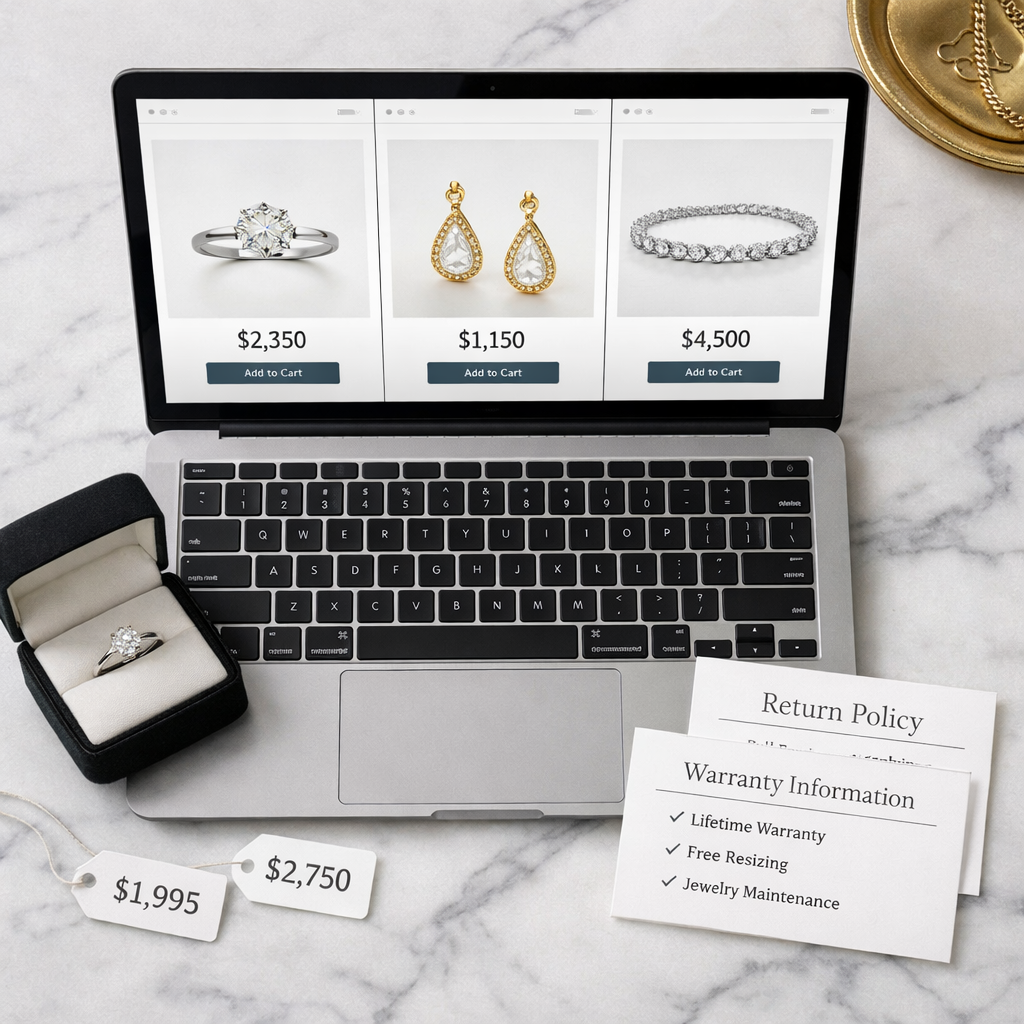
Where to Buy Jewelry Online: Comparing Warranties, Returns, and Prices
Shopping for fine jewelry online is easier than ever, but the best place to buy jewelry online isn’t just the lowest list price—it’s the retailer that pairs clear protections with transparent specs at a fair total cost of ownership. This Jewelry Guidebook guide shows how to compare online jewelry retailers by warranty coverage, return policies, and net price so you can shortlist two to three strong contenders. Along the way, we’ll clarify what buyer protections really mean, how diamond grading and imaging reduce risk, and when extended warranties are worth it.
A jewelry warranty is a promise about condition or performance for a set period, covering defects or specified services (Investopedia on warranties). A return policy sets the rules for sending an item back for refund or exchange within a stated window; research shows leniency is often priced into list prices.
How to compare online jewelry retailers
Use Jewelry Guidebook’s three-column lens—Protections, Transparency, Price—to quickly triage options.
- Protections: warranty type/length, covered maintenance, return window/fees, who pays shipping/insurance, and dispute channels.
- Transparency: grading reports (GIA/IGI), 360°/macro imaging, stone-level specs, metal fineness, clear policy PDFs.
- Price: base price, taxes, shipping, insurance, extended warranty cost, expected service/return costs.
A simple flow:
- Shortlist 2–3 retailers that meet your aesthetic and budget.
- Verify documents: ensure grading reports, stamps, and written policies are accessible.
- Simulate a claim/return: read steps, note who pays shipping, and average timelines.
- Calculate total cost of ownership: purchase price + protection fees + likely service/return costs minus credits.
Buyer protections include warranty scope/term, return rules, and recourse if something goes wrong. Total cost of ownership is the base price plus all add-ons and likely costs over the coverage period. Note: sellers generally price in expected return costs; more lenient returns often mean higher markups.
Key criteria for warranties
A warranty is an explicit or implied promise about a product’s condition or performance for a defined period before expiring. Longer or service-heavy warranties may be separate performance obligations under accounting rules, which affects how they’re designed and priced.
Compare plans with Jewelry Guidebook’s quick-reference table you can fill in:
| Plan | Coverage scope | Term | Key exclusions | Service channel | Claim timeline | Price per year |
|---|---|---|---|---|---|---|
| Example Plan | Prong checks, re-tipping, rhodium, clasp repair | 3 years | Loss/theft, wear, unauthorized work | In-house bench | 5–10 business days | $60/yr |
Coverage scope and exclusions
What’s covered versus normal wear and tear is the heart of a jewelry warranty. Look for specific components:
- Typical inclusions: prong tightening/re-tipping, stone security checks, rhodium re-plating for white gold, chain and clasp repairs, resizing within limits.
- Common exclusions: loss or theft, chips/cracks from impact, routine polishing (if not stated), wear-and-tear, issues after unauthorized repairs or modifications.
Broader coverage usually costs more because the plan shifts from basic assurance to service, which changes expectations and pricing. Consumer tip:
- Rhodium re-plating: reapplying a bright rhodium finish to white gold.
- Prong tightening: securing the tiny metal claws that hold a stone.
- Stone security checks: periodic inspections to catch loosening before loss.
Coverage length and price per year
Normalize value across plans by calculating price per year.
- Example: $180 for a 3-year plan = $60 per year.
- Example: $250 for 5 years = $50 per year, but confirm breadth of coverage to avoid apples-to-oranges comparisons.
Extended warranty contracts should spell out the period, covered events, and compensation rules. The extended warranty market was about $139.1B in 2023 and is projected to reach $232.8B by 2032 at roughly 5.8% CAGR, a scale that reflects both demand and critiques around low utilization and high profitability (market analysis on ScienceDirect). Longer coverage periods increasingly resemble service plans, which influences pricing and what consumers can reasonably expect.
What voids a warranty
Altering or modifying a piece after purchase—like unauthorized resizing, engraving, or third‑party repairs—can nullify warranty coverage. Ask explicitly about:
- Resizing tolerances: how many sizes up/down and within what time frame.
- Who can service the item: approved networks vs. in-house only.
- Documentation: proof-of-service records required to keep coverage valid.
An express warranty is simply a written or verbal promise that a product meets stated specifications.
Claim process and repair partners
Know the pathway before you buy:
- Initiate a claim via portal or support.
- Ship with required insurance and packaging (confirm who pays).
- Inspection and determination (approval or denial).
- Repair or replacement; you may need to reauthorize if costs change.
- Return shipping and final quality check.
Ask retailers to disclose named repair partners or in-house bench capabilities and typical turnaround times for prong work, re-plating, and resizing. Effective warranty pricing and operations depend on product risk and data analytics; mispricing can hurt both providers and consumers by reducing value and slowing service (WTW on warranty program optimization).
Key criteria for return policies
A return policy governs if, when, and how you can send an item back for a refund or exchange. Verify window length, condition requirements, and fees (restocking, label, or insurance). Keep in mind that seller pricing often reflects expected return costs, so very lenient policies can correlate with higher list prices.
Return window and restocking rules
Standard windows run about 14–45 days, with potential holiday extensions. Watch for exceptions on custom or engraved items.
- Inspection criteria: original tags intact, unworn condition, complete paperwork (e.g., lab report).
- Quick math: If you return a $1,000 ring with a 10% restocking fee, your net refund is $900 before shipping/insurance.
Shipping, insurance, and packaging requirements
Clarify logistics to avoid denials:
- Who pays for outbound and return shipping? Are insured labels provided?
- Use trackable, insured carriers; follow any label or RMA instructions.
- Repack in the original box with certificates, appraisals, and accessories; some retailers deduct replacement fees for missing lab reports.
Shipping and insurance can materially change the net price when returns occur—even a $40 insured label on a $300 piece is a double-digit percentage swing.
Exchange, resizing, and customization exceptions
Custom, engraved, and resized items are commonly nonreturnable; some retailers allow exchanges with rework fees.
- Confirm one-time free resizing terms, covered sizes, and shipping responsibilities.
- Customization—any made-to-order change in design, dimensions, or engraving—often affects both return eligibility and warranty scope, so insist on final CAD approvals and written specs.
Refund timing and method
Set expectations before you ship a return.
| Scenario | Retailer processing time | Refund path |
|---|---|---|
| Standard return, in-stock item | 3–10 business days post-inspection | Original payment method |
| Exchange to new size | 1–3 weeks (resizing/production) | Replacement item; price diffs charged/credited |
| Custom piece (nonreturnable) | N/A | Store credit only if stated; fees may apply |
| Missing docs (e.g., lab report) | Add 2–5 days | Partial refund minus replacement fee |
Nonrefundable services usually include expedited shipping, rush production, and independent appraisals.
How protections affect the final price
More generous returns and broader warranties add real value but are usually priced into higher list prices or separate protection fees. Jewelry Guidebook recommends modeling your realistic path: Will you likely need resizing, re-plating, or a potential return? If yes, richer protections can be cheaper overall; if not, a leaner policy may win on net price.
Tradeoffs between generous returns and list prices
Evidence shows sellers incorporate expected return costs into pricing, so a 30–45 day free-returns policy may carry a higher markup than a 14-day, buyer-paid-returns policy. Mini-model:
- Option A: 30-day free returns, expected 8% return rate → implied +3–5% list price cushion.
- Option B: 14-day buyer-paid returns, expected 3% return rate → lower list price, but higher out-of-pocket if you do return. Choose leniency if sizing/fit risk is high (rings, bracelets); choose lower list price if you’re confident in specs and imaging.
Extended warranty pricing and value drivers
Drivers of plan pricing and value:
- Coverage breadth (prongs, re-tipping, re-plating, stone damage), period length, material complexity (platinum vs. gold, pavé vs. solitaire), geography, and historical loss rates. Poor pricing or operational fit erodes consumer value.
- Broader coverage and longer terms cost more; contracts should specify period, covered events, and compensation rules.
- Some less common designs—like residual value warranties or constant coupon warranties—exist in theory and can align incentives differently, though they’re rare in jewelry retail.
Total cost of ownership for common jewelry purchases
Use Jewelry Guidebook’s repeatable formula:
- Base price + sales tax + shipping + insurance + warranty cost (annualized to your horizon) + expected resizing/maintenance − credits/discounts.
Examples:
- Solitaire engagement ring: $3,000 base + $240 tax + $0 ship + $15 insurance + $60/yr maintenance plan (3 years) + $50 rhodium/yr (white gold) − $100 promo = about $3,325 year-one outlay.
- Diamond studs: $800 base + $64 tax + $15 ship + $0 insurance + $0 warranty + $0 maintenance = $879.
- Gold chain: $450 base + $36 tax + $10 ship + $0 insurance + $30/yr plan (2 years) = $556 over two years.
Remember: warranties expire after the stated period; allocate cost only across the covered years.
Retailer types and what to expect
- Brand-owned online stores
- Pros: standardized manufacturer warranties, predictable documentation, access to official service centers/parts.
- Cons: prices may be higher; policies are brand-specific.
- Direct-to-consumer diamond specialists
- Pros: robust 360°/HD imaging, GIA/IGI grading reports, stone-level filtering; clear maintenance options.
- Cons: return and resale terms can differ for lab-grown vs. natural diamonds; read the fine print.
- Multi-brand jewelers with webstores
- Pros: in-store inspection/resizing networks, easier local aftercare, simpler claims logistics.
- Cons: cross-brand policy differences; verify which services apply to online purchases.
- Marketplaces and artisan platforms
- Pros: unique or custom work, direct maker communication.
- Cons: policies vary by seller; confirm materials, service responsibility, and dispute channels.
- Luxury maisons and haute jewelers
- Pros: provenance, documentation, and strong brand service commitments.
- Cons: premium pricing; appointments and insurance requirements can extend timelines.
Tip from Jewelry Guidebook: multi-brand jewelers with physical stores often make real-world warranty use easier through local benches and inspections.
Brand-owned online stores
Expect consistent coverage, brand-defined return windows, and access to official parts and service centers. If the brand sells extended protection, compare price-per-year and confirm what routine maintenance is included.
Direct-to-consumer diamond specialists
Look for 360°/macro imaging, stone plots, and grading from GIA or IGI. Clarify differences in returns and resale values for lab-grown versus natural stones, and check stone-level coverage (e.g., chipped girdles) plus routine maintenance terms.
Multi-brand jewelers with webstores
Benefit from in-store inspections, resizing, and repairs that reduce shipping risks for claims. Ask whether online purchases qualify for local service and confirm any variations in return windows or restocking by brand.
Marketplaces and artisan platforms
Do due diligence seller by seller: ratings, response times, and custom policies vary widely. Require clear metal fineness stamps and gemstone disclosures, and confirm who services defects. Use platform buyer protections and dispute resolution when available.
Luxury maisons and haute jewelers
Expect premium pricing tied to provenance, craftsmanship, and tailored service. Confirm repair logistics, insurance requirements for shipments, and appointment-based timelines. Strong protections are part of the value—but they’re reflected in the list price.
Side-by-side evaluation checklist
Use Jewelry Guidebook’s printable matrix to compare finalists:
| Retailer | Warranty scope/term | Exclusions | Return window/fees | Shipping responsibility | Imaging/certs | Service turnaround | Final price est. |
|---|---|---|---|---|---|---|---|
| Retailer A | Prongs, re-plating, 3 yrs | Loss, unauthorized work | 30 days, free | Seller pays both ways | 360°, GIA | 7–10 biz days | $X total |
| Retailer B | Prongs only, 1 yr | Wear, resizing | 14 days, $20 label | Buyer return-paid | HD photos, IGI | 10–15 biz days | $Y total |
| Retailer C | Plan optional, 5 yrs | Impact damage | 45 days, 10% fee | Mixed | Macro + report | 5–7 biz days | $Z total |
Documentation and grading
- Require diamond grading reports (GIA/IGI) and metal fineness stamps; these are part of the seller’s express warranty—a promise that the item meets stated specs.
- Keep receipts, certificates, and photos for claims and future resale.
Imaging and product transparency
- Expect consistent 360°/macro images, videos, measurements, and stone plots under neutral lighting.
- List stone specs (carat, color, clarity, cut) and metal details (karat, plating, finishes).
- Better imaging reduces mismatch returns, which also influences pricing.
Service access and turnaround times
- Ask for average repair/resize timelines and whether work is in-house or via partners.
- Note shipping label issuance times and any loaner options.
- Operational efficiency and risk management are core to warranty pricing and value in practice.
Buyer protections and dispute resolution
- Identify dispute channels: credit card chargebacks, platform protections, or third-party mediation, plus stated response SLAs.
- Save chats/emails and insured shipping receipts for claims.
- Remember: generous return policies can raise list prices; weigh net value against your fit/risk profile.
Recommendations by shopper priority
Best for maximum protections
- Look for ≥30–45 day free returns, insured labels, and comprehensive maintenance (prong checks, re-polishing, re-plating).
- Expect higher list prices to reflect these benefits; choose if sizing uncertainty or daily wear risk is high.
Best for lowest total price
- Choose lean return policies with low/no restocking, buyer-paid return shipping, and skip extended warranties unless your wear pattern is high-risk.
- Compare price-per-year for any plan and verify shipping responsibilities to avoid surprise costs.
Best for customization and service access
- Favor retailers with transparent custom policies, clear nonreturnable terms, and local or partner benches for aftercare.
- Document CAD approvals and final specs to support any defect claims and keep warranty eligibility intact.
Best for rare or artisan pieces
- Use marketplaces or artisan platforms with top ratings, explicit material disclosures, and written warranty/repair terms.
- Rely on platform buyer protections and agree on insured, trackable shipping.
How to verify policies before you buy
Save the fine print now so future claims are hassle-free.
Where to find the fine print
- Check footer policy links, product pages, checkout modals, and order confirmations.
- Download warranty/return PDFs and screenshot key terms like coverage, exclusions, and shipping responsibility.
Questions to ask support
- What exactly is covered, and what voids coverage?
- Who pays shipping/insurance for returns and claims?
- Average turnaround for resizing, prong work, re-plating?
- Are lab reports included? How are custom orders handled?
- Who are your repair partners, and what are the claim steps with timelines?
How to document eligibility
- Keep receipts, certificates, unboxing photos, and arrival-condition videos.
- Maintain service records and use only authorized jewelers to avoid voiding coverage.
Frequently asked questions
What is the difference between a warranty and a return policy?
A warranty promises your jewelry’s condition or performance for a set period, while a return policy governs if and how you can send an item back for a refund or exchange. Jewelry Guidebook recommends confirming both in writing before purchase.
Are extended jewelry warranties worth the cost?
They can be for daily-wear pieces; compare price-per-year, covered maintenance, exclusions, and who pays shipping to decide. Jewelry Guidebook’s simple cost-per-year method helps you weigh value.
Who pays for shipping and insurance on returns or repairs?
It varies by retailer; Jewelry Guidebook recommends confirming both directions in writing and keeping insured shipping receipts.
Can resizing or third-party work void my warranty?
Often yes—unauthorized resizing, engraving, or repairs commonly void coverage. Use approved service networks and keep records, as Jewelry Guidebook’s checklist suggests.
What certifications and documents should accompany fine jewelry?
Look for GIA/IGI grading for diamonds, metal fineness stamps, and itemized receipts. Jewelry Guidebook suggests saving digital copies of all documents and unboxing photos.